MCQ
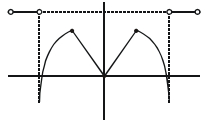
A function $f$ is defined on $[-3,3]$ as

$f(x)=\left\{\begin{array}{cc}\min \left\{|x|, 2-x^{2}\right\} & , \quad-2 \leq x \leq 2 \\ {[|x|]} & , \quad 2<|x| \leq 3\end{array}\right.$

where $[x]$ denotes the greatest integer $\leq x .$ The number of points, where $f$ is not differentiable in $(-3,3)$ is

  • A
    $10$
  • B
    $2$
  • $5$
  • D
    $8$

Answer

Correct option: C.
$5$
c
$f(x)=\left\{\begin{array}{cc}\min \left\{|x|, 2-x^{2}\right\} & , \quad-2 \leq x \leq 2 \\ {[|x|]} & , \quad 2<|x| \leq 3\end{array}\right.$

$\Rightarrow x \in[-3,-2) \cup(2,3]$

Number of points of non-differentiability in $(-3,3)=5$

Need a full question paper?

Generate a complete, print-ready paper with questions like this in minutes — across 16+ boards, with answer keys.

Start Generating Free

Similar questions

Degree of the given differential equation ${\left( {\frac{{{d^2}y}}{{d{x^2}}}} \right)^3} = {\left( {1 + \frac{{dy}}{{dx}}} \right)^{1/2}}$, is
If the straight lines $\vec r=$$(1,2,3)+k(\lambda ,2,3),k \in R$  and $\vec r=$$(2,3,1) +k(3,\lambda ,2),k \in R$ intersect at a point , then the interger $\;\lambda $ is equal to . 
The solution set of the inequation 3x + 2y > 3 is:
$\text{Area}\text{ of}\text{ ellips}\frac{\text{x}^2}{\text{a}^2}+\frac{\text{y}^2}{\text{b}^2}=1\text{ is:}$
  1. $4\pi\text{ ab}\text{ sq.}\text{ units}$
  2. $2\pi\text{ ab}\text{ sq.}\text{ units}$
  3. $\pi\text{ ab}\text{ sq.}\text{ units}$
  4. $\frac{\pi\text{ab}}{2}\text{ sq.}\text{ units}$
If $x = {{3at} \over {1 + {t^3}}},y = {{3a{t^2}} \over {1 + {t^3}}},$ then ${{dy} \over {dx}} =$
$\mathop {\lim }\limits_{n \to \infty } {\left[ {\frac{{n!}}{{{n^n}}}} \right]^{1/n}}$ equals
Three persons, A, B and C fine a target in turn starting with A. Their probability of hitting the target are 0.4, 0.2 and 0.2, respectively. The probability of two hits is
  1. 0.024
  2. 0.452
  3. 0.336
  4. 0.188
The solution of the equation $\frac{d y}{d x}=\frac{1-\cos 2 y}{1+\cos 2 y}$ is :
If the vectors $3\hat{\text{i}}+\lambda\hat{\text{j}}+\hat{\text{k}}$ and $2\hat{\text{i}}-\hat{\text{j}}+8\hat{\text{k}}$ are perpendicular, then $\lambda$ is equal to: 
  1. $-14$
  2. $7$
  3. $14$
  4. $\frac{1}{7}$
If $\text{f}(\text{x})=\Big(\frac{\text{x}^\text{l}}{\text{x}^\text{m}}\Big)^{\text{l}+\text{m}}\Big(\frac{\text{x}^\text{m}}{\text{x}^\text{n}}\Big)^{\text{m}+\text{n}}\Big(\frac{\text{x}^\text{n}}{\text{x}^\text{l}}\Big)^{\text{n}+1},$ the f'(x) is equal to:
  1. 1
  2. 0
  3. xl+m+n
  4. None of these.