MCQ
A galvanometer can be used as a voltmeter by connecting a
  • High resistance in series
  • B
    Low resistance in series
  • C
    High resistance in parallel
  • D
    Low resistance in parallel

Answer

Correct option: A.
High resistance in series
a
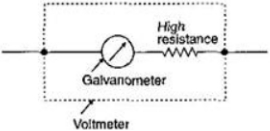
A galvanometer has its own resistance low but a voltmeter must have high resistance. $A$ voltmeter indeed is a modified form of a pivoted coil galvanometer. since the resistance of coil of galvanometer of its own is low, its resistance is to be increased as is a necessary condition for a voltmeter. For this an appropriate high resistance should be connected in series with the galvanometer as shown. 

Note$:$The resistance of an ideal voltmeter should be infinite.
Need a full question paper?

Generate a complete, print-ready paper with questions like this in minutes — across 16+ boards, with answer keys.
Start Generating Free

Similar questions

What type of lens from the following would you have in your magnifying lens to read a page in small print?
Ina hydrogen atom, the binding energy of the electron in the $n^{th}$ state is $E_n$, then the frquency of revolutionof the electron in the nth orbits is:
Two lenses have focal lengths ${f_1}$ and ${f_2}$ and their dispersive powers are ${\omega _1}$ and ${\omega _2}$ respectively. They will together form an achromatic combination if
A wire of diameter $0.02\,meter$ contains $10^{28}$ free electrons per cubic meter. For an electrical current of $100\, A$, the drift velocity of the free electrons in the wire is nearly
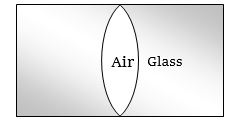
In the figure, an air lens of radii of curvature $10 cm$ (${R_1}$ = ${R_2}$ $= 10 cm$) is cut in a cylinder of glass $(\mu = 1.5)$. The focal length and the nature of the lens is
A double convex lens $\left(\mathrm{R}_1=\mathrm{R}_2=10 \mathrm{~cm}\right)(\mu=1.5)$ having focal length equal to the focal length of a concave mirror. The radius of curvature of the concave mirror is
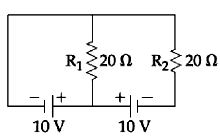
In the given circuit the cells have zero internal resistance. The currents (in Amperes) passing through resistance $R_1$ and $R_2$ respectively, are
Critical angle for light going from medium (i) to (ii) is q. The speed of light in medium (i) is v then speed in medium (ii) is
In a uniform magnetic field of $0.049 \mathrm{~T}$, a magnetic needle performs $20$ complete oscillations in $5$ seconds as shown. The moment of inertia of the needle is $9.8 \times 10^{-5} \mathrm{~kg} \mathrm{~m}^2$. If the magnitude of magnetic moment of the needle is $x \times 10^{-5} \mathrm{Am}^2$, then the value of ' $x$ ' is :
An $N-$ type and $P-$ type silicon can be obtained by doping pure silicon with