MCQ
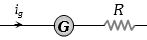
A galvanometer has $30$ divisions and a sensitivity $16\,\mu A/{\rm{div}}{\rm{.}}$ It can be converted into a voltmeter to read $3\, V$ by connecting
  • Resistance nearly $6 \,k\,\Omega $ in series
  • B
    $6\,k\,\Omega $ in parallel
  • C
    $500\,\Omega $ in series
  • D
    It cannot be converted

Answer

Correct option: A.
Resistance nearly $6 \,k\,\Omega $ in series
(a) $(R + G)\,{i_g} = V$

$ \Rightarrow $ $(R + G) = \frac{V}{{{i_g}}}$

$ = \frac{3}{{30 \times 16 \times {{10}^{ - 6}}}} = 6.25\,k\Omega $

$\therefore $ Value of $R$ is nearly equal to $6\,k\Omega $

This is connected in series in a voltmeter.

Need a full question paper?

Generate a complete, print-ready paper with questions like this in minutes — across 16+ boards, with answer keys.

Start Generating Free

Similar questions

A resistance $R$ is stretched to four times its length. Its new resistance will be
In hydrogen spectrum the wavelength of $H _\alpha$ line is $656 nm$ whereas in the spectrum of a distant galaxy, $H _\alpha$ line wavelength is $706 nm$. Estimated speed of the galaxy with respect to earth is [IIT-JEE 1999; UPSEAT 2003]
Two identical plates of different metals are joined to form a single plate whose thickness is double the thickness of each plate. If the coefficients of conductivity of each plate are 2 and 3 respectively, then the conductivity of composite plate will be
A stone is projected from the ground with velocity $25 m / s$. Two seconds later, it just clears a wall $5 m$ high. The angle of projection of the stone is $\left(g=10 m / \sec ^2\right)$
In isothermic process, which statement is wrong
A coil of $200\  \Omega$ resistance and $1.0\  H$ inductance is connected to an ac source of frequency $200 / 2 \pi \ Hz$. Phase angle between potential and current will be
An ideal gas is expanded adiabatically at an initial temperature of $300 K$ so that its volume is doubled. The final temperature of the hydrogen gas is $(\gamma=1.40)$
At magnetic poles of earth, angle of dip is
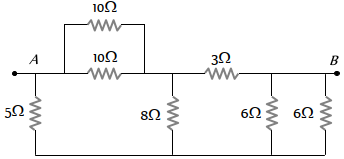
Seven resistances are connected as shown in the figure. The equivalent resistance between $A$ and $B$ is

Image

A $1\  \mu \mathrm{A}$ beam of protons with a cross-sectional area of $0.5 \ \mathrm{sq} . \mathrm{mm}$ is moving with a velocity of $3 \times 10^4 \mathrm{~ms}^{-1}$. Then charge density of beam is