MCQ
A galvanometer having a coil resistance $100 \;\Omega$ gives a full scale deflection when a current of $1 \;\mathrm{mA}$ is passed through it. What is the value of the resistance which can convert this galvanometer into a voltmeter giving full scale deflection for a potential difference of $10\; \mathrm{V} ?$......$k\Omega$
  • A
    $9.9$
  • B
    $8.9$
  • C
    $7.9$
  • D
    $10$

Answer

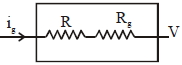
$\mathrm{i}_{\mathrm{g}}=1 \mathrm{mA}, \mathrm{R}_{\mathrm{g}}=100 \Omega$

$\mathrm{V}=\mathrm{i}_{\mathrm{g}}\left(\mathrm{R}+\mathrm{R}_{\mathrm{g}}\right)$

$10=1 \times 10^{-3}(\mathrm{R}+100)$

$\mathrm{R}=9.9 \mathrm{k} \Omega$

Need a full question paper?

Generate a complete, print-ready paper with questions like this in minutes — across 16+ boards, with answer keys.

Start Generating Free

Similar questions

A particle executing simple harmonic motion of amplitude $5 cm$ has maximum speed of $31.4 cm / s$. The frequency of its oscillation is
A galvanometer has a resistance of $25 \mathrm{ohm}$ and a maximum of 0.01 $A$ current can be passed through it. In order to change it into an ammeter of range $10 \mathrm{~A}$, the shunt resistance required is
If an ammeter is connected in parallel to a circuit, it is likely to be damaged due to excess
Efficiency of Carnot engine is $100 \%$ if
A wire of length $L$ and radius $r$ is rigidly fixed at one end. On stretching the other end of the wire with a force $F$, the increase in its length is $l$. If another wire of same material but of length $2 L$ and radius $2 r$ is stretched with a force of $2 F$, the increase in its length will be
A person cannot see objects clearly beyond $2.0 \mathrm{~m}$. The power of lens required to correct his vision will be
For a material, the refractive indices for red, violet and yellow colour light are respectively $1.52,1.64$ and $1.60.$ The dispersive power of the material is
An electron (charge $=1.6 \times 10^{-19} \mathrm{C}$ ) is accelerated through a potential of $100,000 \mathrm{~V}$. The energy acquired by the electron is
The equation of state of some gases can be expressed as $\left(P+\frac{a}{V^2}\right)(V-b)=R T$. Here $P$ is the pressure, $V$ is the volume, $T$ is the absolute temperature and $a, b, R$ are constants. The dimensions of ' $a$ ' are
A $500 kg$ crane takes a turn of radius $50 m$ with velocity of 36 $km / hr$. The centripetal force is