Question
(a) Give one example of forced vibrations.
(b) How is the frequency of a stretched string related to (i) its length, and (ii) its tension?

Answer

(a) When the handle of vibrating tuning fork is placed on a table top, the table produce forced vibrations.
(b) (i) Frequency is inversely proportional to the length of string.
(ii) Frequency is directly proportional to the square root of tension.

Need a full question paper?

Generate a complete, print-ready paper with questions like this in minutes — across 16+ boards, with answer keys.
Start Generating Free

Similar questions

State two conditions for work to be done.
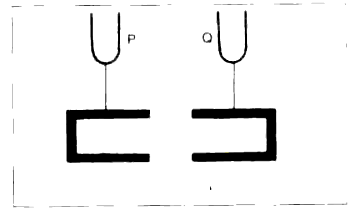
In fig. shows two tuning forks P and Q of the same frequency mounted on separate sound boxes with their open ends facing each other. The fork A is set into vibration. (i) Describe your observation. (ii) State the principle illustrated by this experiment.
(a) At what voltage is current available in our household?
(b) How is the magnetic field due to a straight current carrying wire affected if current in the wire is decreased?
(c) How is the magnetic field due to a straight current carrying wire affected if current in the wire is reversed?
Name the S.I. unit of electrical energy. How is it related to Wh?
State the principle of calorimetry.
Why does the sky appear blue on the earth, but black on the moon?
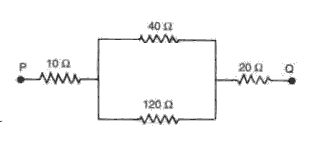
Find the effective resistance in the following circuit diagrams (Fig.):

Image

A ray of light incident at an angle of incidence i1 passes through an equilateral glass prism such that the refracted ray inside the prism is parallel to its base and emerges at an angle of emergence i2. (i) How is the angle of emergence ‘i2’ related to the angle of incidence ‘i2’. (ii) what can you say about the angle of deviation in such a situation?
Explain why strings of different thicknesses are provided on a stringed instrument.
[Hint : Natural frequency of vibration of a stretched string is inversely proportional to the radius (or thickness) of string so notes of different frequencies can be produces by vibrating different strings.]
(i) State the relationship between mechanical advantage, velocity ratio and efficiency.
(ii) Name the term that will not change for a machine of a given design.