A graph of the square of the velocity against the square of the acceleration of a given simple harmonic motion is
- A
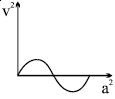
- B
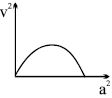
- C
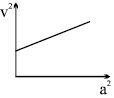
- D
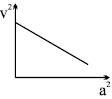
Diffcult


Download our appand get started for free
Experience the future of education. Simply download our apps or reach out to us for more information. Let's shape the future of learning together!No signup needed.*
Similar Questions
- 1The angular velocities of three bodies in simple harmonic motion are ${\omega _1},\,{\omega _2},\,{\omega _3}$ with their respective amplitudes as ${A_1},\,{A_2},\,{A_3}$. If all the three bodies have same mass and velocity, thenView Solution
- 2A particle moves with simple harmonic motion in a straight line. In first $\tau \,s$, after starting from rest, it travels a distance $a$, and in next $\tau \,s$, it travels $2a$ in same direction thenView Solution
- 3View SolutionThe phase difference between the instantaneous velocity and acceleration of a particle executing simple harmonic motion is
- 4The amplitude of a particle executing $SHM$ is $4 \,cm$. At the mean position the speed of the particle is $16\, cm/sec$. The distance of the particle from the mean position at which the speed of the particle becomes $8\sqrt 3 \,cm/s,$ will be .... $cm$View Solution
- 5Kinetic energy of a particle executing simple harmonic motion in straight line is $pv^2$ and potential energy is $qx^2$, where $v$ is speed at distance $x$ from the mean position. It time period is given by the expressionView Solution
- 6View SolutionA particle of mass m is hanging vertically by an ideal spring of force constant K. If the mass is made to oscillate vertically, its total energy is
- 7The displacement of a particle varies according to the relation $x$ = $3 sin100t + 8cos^2 50t$. Which of the following is $INCORRECT$ about this motionView Solution
- 8A particle performs $S.H.M.$ of amplitude $A$ with angular frequency $\omega$ along a straight line. Whenit is at a distance $\frac{{\sqrt 3 }}{2}$ $A$ from mean position, its kinetic energy gets increased by an amount $\frac{1}{2}m{\omega ^2}{A^2}$ due to an impulsive force. Then its new amplitude becomesView Solution
- 9View SolutionWhen a particle executes simple Harmonic motion, the nature of graph of velocity as function of displacement will be.
- 10View SolutionWhat will be the force constant of the spring system shown in the figure