MCQ
A graph plotted between $\log \,K$ vs $ 1/T$ for calculating activation energy is shown by
- A
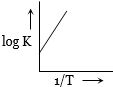
- ✓
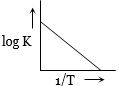
- C
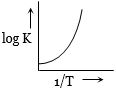
- D
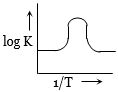
from Arrhenius equation
$\log \,k = \log \,A - \frac{{{E_A}}}{{2.303\,RT}}$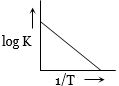
Generate a complete, print-ready paper with questions like this in minutes — across 16+ boards, with answer keys.
$2 \mathrm{~K}_{2} \mathrm{Cr}_{2} \mathrm{O}_{7}+8 \mathrm{H}_{2} \mathrm{SO}_{4}+3 \mathrm{C}_{2} \mathrm{H}_{6} \mathrm{O} \rightarrow 2 \mathrm{Cr}_{2}\left(\mathrm{SO}_{4}\right)_{3}+$
$3 \mathrm{C}_{2} \mathrm{H}_{4} \mathrm{O}_{2}+2 \mathrm{~K}_{2} \mathrm{SO}_{4}+11 \mathrm{H}_{2} \mathrm{O}$
If the rate of appearance of $\mathrm{Cr}_{2}\left(\mathrm{SO}_{4}\right)_{3}$ is $2.67 \,\mathrm{~mol}$ $\min ^{-1}$ at a particular time, the rate of disappearance of $\mathrm{C}_{2} \mathrm{H}_{6} \mathrm{O}$ at the same time is ...... $\mathrm{mol}\, \mathrm{min}^{-1}$ (Nearest integer)
Which of the following reactants will complete the above reaction ?
Reason: The electrical conductivity of metals is due to motion of electrons.
$C{H_3} - \mathop {\mathop {CH - }\limits_{|\,\,\,\,\,\,\,} }\limits_{C{H_3}\,} C{H_2} - C{H_2} - Cl$