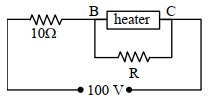
A heater is designed to operate with a power of $1000 \mathrm{~W}$ in a $100 \mathrm{~V}$ line. It is connected in combination with a resistance of $10 \Omega$ and a resistance $R$, to a $100 \mathrm{~V}$ mains as shown in figure. For the heater to operate at $62.5 \mathrm{~W}$, the value of $\mathrm{R}$ should be .................. $\Omega$.
JEE MAIN 2024, Diffcult
Download our app for free and get started
$R_{\text {heater }}=\frac{V^2}{P}=\frac{(100)^2}{1000}=10 \Omega$
For heater $P=\frac{V^2}{R} \Rightarrow V=\sqrt{P R}$
$\mathrm{V}=\sqrt{62.5 \times 10}$
$\mathrm{~V}=25 \mathrm{v}$
(Image)
$i_1=\frac{75}{10}=7.5 A, i_H=\frac{25}{10}=2.5 A$
$i_R=i_1-i_H=5$
$V=I R$
$R=\frac{25}{5}=5 \Omega$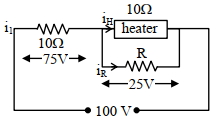

Download our appand get started for free
Experience the future of education. Simply download our apps or reach out to us for more information. Let's shape the future of learning together!No signup needed.*
Similar Questions
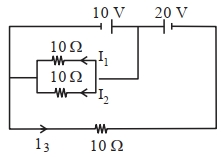
- 1In the given circuit the value of $\left|\frac{I_1+I_3}{I_2}\right|$ isView Solution
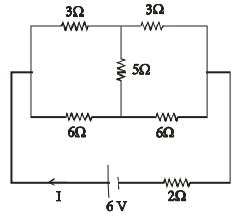
- 2A battery of $6\,V$ is connected to the circuit as shown below. The current I drawn from the battery is:View Solution
- 3View SolutionWhich device can convert all electrical energy into heat
- 4Two long coaxial and conducting cylinders of radius $a$ and $b$ are separated by a material of conductivity $\sigma$ and a constant potential difference $V$ is maintained between them, by a battery. Then the current, per unit length of the cylinder flowing from one cylinder to the other is -View Solution
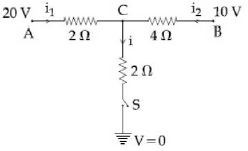
- 5When the switch $S$, in the circuit shown, is closed, then the value of current $i$ will be ................. $A$View Solution
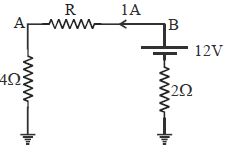
- 6View SolutionIn the given circuit
- 7The series combination of two batteries, both of the same emf $10 \mathrm{\;V},$ but different internal resistance of $20\; \Omega$ and $5\; \Omega,$ is connected to the parallel combination of two resistors $30\; \Omega$ and $\mathrm{R}\; \Omega .$ The voltage difference across the battery of internal resistance $20\; \Omega$ is zero, the value of $\mathrm{R}(\text { in } \Omega)$ isView Solution
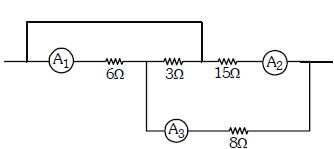
- 8A part of circuit is shown in figure. All the ammeters are ideal. If reading of ammeter $A_1$ is $1.0\ A$ , thenView Solution
- 9The resistance of a conductor at $15^{\circ} {C}$ is $16\, \Omega$ and at $100\, {C}$ is $20\, \Omega$. What will be the temperature coefficient of resistance of the conductor?View Solution
- 10A wire of resistance $12\,ohms$ per meter is bent to form a complete circle of radius $10\, cm.$ The resistance between its two diametrically opposite points, $A$ and $B$ as shown in the figure isView Solution