Question
A heating element using nichrome connected to a 230 V supply draws an initial current of 3.2 A which settles after a few seconds to a steady value of 2.8 A. What is the steady temperature of the heating element if the room temperature is 27${ }^{\circ} C$ ? Temperature coefficient of resistance of nichrome averaged over the temperature range involved is $1.70 \times 10^{-4}{ }^{\circ} C ^{-1}$.
Answer

Given that :
Magnitude of supply voltage, V $=230 V$
Initial current, $I _1=3.2 A$
Room temperature $T _1=27^{\circ} C$
Constant current, $I _2=2.8 A$
Constant temperature $T _2=$ ?
Temperature coefficient of resistance
$\alpha=1.7 \times 10^{-4}{ }^{\circ} C ^{-1}$
If $R_1$ and $R_2$ are resistances of the wire at temperatures $T_1$ and $T_2$ respectively, then
Formula $\quad R _1=\frac{ V }{ I _1}=\frac{230}{3.2}=71.875 \Omega$
$R _2=\frac{ V }{ I _2}=\frac{230}{2.8}=82.143 \Omega$
Formula $\quad \alpha=\frac{ R _2- R _1}{ R _1\left(T_2- T _1\right)}$
$T _2- T _1=\frac{ R _2- R _1}{ R _1 \alpha}$
$\Rightarrow \quad T _2-27^{\circ} C =\frac{82.143-71.875}{71.875 \times 1.7 \times 10^{-4}}=\frac{10.268}{122.19 \times 10^{-4}}$
$\Rightarrow \quad T _2-27^{\circ} C =\frac{10.268}{122.19 \times 10^{-4}}=840.35$
$T _2=840.35+27=867.35^{\circ} C$

Need a full question paper?

Generate a complete, print-ready paper with questions like this in minutes — across 16+ boards, with answer keys.

Start Generating Free

Similar questions

Explain giving reasons for the following:
  1. Photoelectric current in a photocell increases with the increase in the intensity of the incident radiation.
  2. The stopping potential $(V_0)$ varies linearly with the frequency $(v)$ of the incident radiation for a given photosensitive surface with the slope remaining the same for different surfaces.
  3. Maximum kinetic energy of the photoelectrons is independent of the intensity of incident radiation.
The electric current in an $X-$ray tube $($from the target to the filament$)$ operating at $40\ kV$ is $10\ mA$. Assume that on an average$, 1\%$ of the total kinetic energy of the electron hitting hte target are converted into $X-$rays.
  1. What is the total power emitted as $X-$rays
  2. How much heat is produced in the target every second?
A regular hexagon of side 10 cm has a charge of 5 $\mu C$ at each of its vertex. Calculate the potential at the centre of the hexagon.
In an experiment on photoelectric effect, the slope of the cut$-$off voltage versus frequency of incident light is found to be $4.12 \times 10^{–15} Vs.$ Calculate the value of Planck’s constant.
Why are the magnification properties of microscopes and telescopes defined in terms of the ratio of angles and not in terms of the ratio of sizes of objects and images?
State briefly the underlying principle of a transistor oscillator. Draw a circuit diagram showing how the feedback is accomplished by inductive coupling. Explain the oscillator action.
The electric field in a region is given by $\overrightarrow{\text{E}}=\frac{3}{5}\text{E}_0\overrightarrow{\text{i}}+\frac{4}{5}\text{E}_0\overrightarrow{\text{j}}$ with $\text{E}_0=2.0\times10^3\text{NC}^{-1}.$ Find the flux of this field through a rectangular surface of area $0.2m^2$ parallel to the $y-z$ plane.
A coil of cross $-$ sectional area A lies in a uniform magnetic field $B$ with its plane perpendicular to the field. In this position the normal to the coil makes an angle of $0^\circ$ with the field. The coil rotates at a uniform rate to complete one rotation in time $T$. Find the average induced emf in the coil during the interval when the coil rotates:
$i$. from $0^{\circ}$ to $90^{\circ}$ position
$ii$. from $90^{\circ}$ to $180^{\circ}$ position
$iii$. from $180^{\circ}$ to $270^{\circ}$ and
$iv$. from $270^{\circ}$ to $360^{\circ}$
What are the advantages of using soft iron as a core, instead of steel, in the coils of galvanometers?
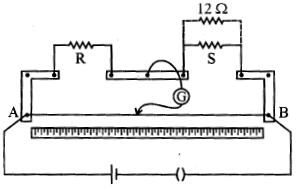
In a meter bridge, the null point is found at a distance of 40 cm from A. If a resistance of 12 Ω is connected in parallel with S, the null point occurs at 50.0 cm from. Determine the values of R and S.