MCQ
A helicopter reises from rest on the ground vertically upwards with a constant acceleration $g.$ A food packet is dropped from the helicopter when it is a height $h$. The time taken by the packet to reach the ground is close to $[ g$ is the acceleration due to gravity]
  • A
    $t =\sqrt{\frac{2 h }{3 g }}$
  • B
    $t=1.8 \sqrt{\frac{h}{g}}$
  • $t=3.4 \sqrt{\left(\frac{h}{g}\right)}$
  • D
    $t=\frac{2}{3} \sqrt{\left(\frac{h}{g}\right)}$
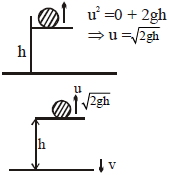
Answer

Correct option: C.
$t=3.4 \sqrt{\left(\frac{h}{g}\right)}$
c
$t_{0}=\sqrt{\frac{2 h}{g}}$

$\Rightarrow \quad u=\sqrt{\frac{2 h}{g}} \times g=\sqrt{2 g h}$

$\therefore \quad t_{1}=$time to reach top $=\frac{u}{g}=\sqrt{\frac{2 h}{g}}$

$\therefore \quad H=h+h^{\prime}=2 h$

$t_{2}=$ time of fall $=\sqrt{\frac{2 \times(2 h)}{g}}$

$\quad=2 \sqrt{\frac{h}{g}}$

Total time $=t_{1}+t_{2}$

$\quad=(2+\sqrt{2}) \sqrt{\frac{h}{g}}$

$\quad=3.4 \sqrt{\frac{h}{g}}$

Need a full question paper?

Generate a complete, print-ready paper with questions like this in minutes — across 16+ boards, with answer keys.

Start Generating Free

Similar questions

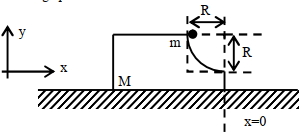
A block of mass $M$ has a circular cut with a frictionless surface as shown. The block rests on the horizontal frictionless surface of a fixed table. Initially the right edge of the block is at $x=0$, in a co-ordinate system fixed to the table. A point mass $m$ is released from rest at the topmost point of the path as shown and it slides down. When the mass loses contact with the block, its position is $\mathrm{x}$ and the velocity is $\mathrm{v}$. At that instant, which of the following options is/are correct?

(image)

$[A]$ The $x$ component of displacement of the center of mass of the block $M$ is : $-\frac{m R}{M+m}$.

[$B$] The position of the point mass is : $x=-\sqrt{2} \frac{\mathrm{mR}}{\mathrm{M}+\mathrm{m}}$.

[$C$] The velocity of the point mass $m$ is : $v=\sqrt{\frac{2 g R}{1+\frac{m}{M}}}$.

[$D$] The velocity of the block $M$ is: $V=-\frac{m}{M} \sqrt{2 g R}$.

The equation of a progressive wave is given by $y = a\sin (628t - 31.4x)$

If the distances are expressed in cms and time in seconds, then the wave velocity will be ...... $cm/sec$

A body is released from a height equal to the radius ( $R$ ) of the earth. The velocity of the body when it strikes the surface of the earth will be :

(Given $g$ = acceleration due to gravity on the earth.)

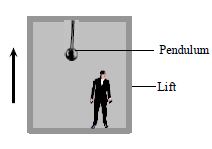
A man measures the period of a simple pendulum inside a stationary lift and finds it to be $T$ $s$. If the life accelerates upwards with an acceleration $g/4$, then the period of the pendulum will be
Three vectors $\vec{\text{A}},\ \vec{\text{B}}$ and $\vec{\text{C}}$ add up to zero. Find which is false.
Calculate energy needed for moving a mass of $4\,\,kg$ from the centre of the earth to its surface (in joule), if radius of the earth is $6400\,\, km$ and acceleration due to gravity at the surface of the earth is $g = 10 \,\,m/sec^2.$
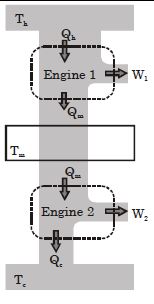
Suppose that two heat engines are connected in series, such that the heat released by  the first engine is used as the heat absorbed by the second engine, as shown in figure. The efficiencies of the engines are $\in_1$ and $\in_2$, respectively. The net efficiency of the combination is given by :
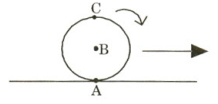
A sphere is rolling without slipping on a fixed horizontal plane surface. In the figure, $\mathrm{A}$ is the point of contact, $\mathrm{B}$ is the centre of the sphere and $\mathrm{C}$ is its topmost point. Then,

$(A)$ $\vec{V}_C-\vec{V}_A=2\left(\vec{V}_B-\vec{V}_C\right)$

$(B)$ $\vec{V}_C-\vec{V}_B=\vec{V}_B-\vec{V}_A$

$(C)$ $\left|\vec{V}_C-\vec{V}_A\right|=2\left|\vec{V}_B-\vec{V}_C\right|$

$(D)$ $\left|\vec{V}_C-\vec{V}_A\right|=4\left|\vec{V}_B\right|$

Which is the quantity which remains conserved in both elastic and inelastic collisions?
Two waves are propagating along a taut string that coincides with the $x-$axis. The first wave has the wave function $y_1 = A cos [k(x - vt)]$ and the second has the wave function $y = A cos [k(x + vt) + \phi ]$.