MCQ
A hole is :
  • A
    A positively charged electron.
  • B
    An electron in the valence band.
  • An unfilled covalent bond.
  • D
    An excess electron in covalent bond.

Answer

Correct option: C.
An unfilled covalent bond.
When the covalent bond breaks, electrons are freed from atom. The departure of electron from valence band creates vacancy in bond, this vacancy is known as hole. Hence, a hole is an unfilled covalent bond.

Need a full question paper?

Generate a complete, print-ready paper with questions like this in minutes — across 16+ boards, with answer keys.

Start Generating Free

Similar questions

If A and B are two inputs in AND gate, then AND gate has an output of 1 when the values of A and B are
An object is at a distance of 0.5 m in front of a plane mirror. Distance between the object and image is
Sun light falls normally on a surface of area $36\,cm ^{2}$ and exerts an average force of $7.2 \times 10^{-9}\,N$ within a time period of $20$ minutes. Considering a case of complete absorption, the energy flux of incident light is.
The hottest planet of solar system is
An inductance coil has a reactance of $100\, \Omega$. When an $AC$ signal of frequency $1000\, Hz$ is applied to the coil, the applied voltage leads the current by $45^{\circ}$. The self- inductance of the coil is
Which reaction is not part of proton-proton cycle
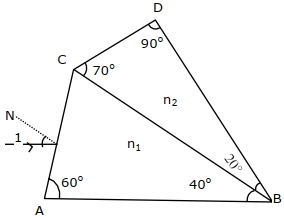
A prism of refractive index $n_{1}$ and another prism of refractive index $n_{2}$ are stuck together (as shown in the figure). $n_{1}$ and $n_{2}$ depend on $\lambda$, the wavelength of light, according to the relation

${n}_{1}=1.2+\frac{10.8 \times 10^{-14}}{\lambda^{2}} \text { and } {n}_{2}=1.45+\frac{1.8 \times 10^{-14}}{\lambda^{2}}$

The wavelength for which rays incident at any angle on the interface $B C$ pass through without bending at that interface will be $....\,nm.$
A Hydrogen-like atom has atomic number $Z$. Photons emitted in the electronic transitions from level $n=4$ to level $n=3$ in these atoms are used to perform photoelectric effect experiment on a target metal. The maximum kinetic energy of the photoelectrons generated is $1.95 \mathrm{eV}$. If the photoelectric threshold wavelength for the target metal is $310 \mathrm{~nm}$, the value of $Z$ is. . . . . . .[Given: $h c=1240 \mathrm{eV}-\mathrm{nm}$ and $R h c=13.6 \mathrm{eV}$, where $R$ is the Rydberg constant, $h$ is the Planck's constant and $c$ is the speed of light in vacuum]
A charge $Q$ is moving $\overrightarrow{dl}$ distance in the magnetic field $\overrightarrow{ B }$. Find the value of work done by $\overrightarrow{ B }$.
A wave is propagating in a medium of electric dielectric constant 2 and relative magnetic permeability 50. The wave impedance of such a medium is