Question
A horizontal cesium plate ($\phi$ = 1.9eV) is moved vertically downward at a constant speed u in a room full of radiation of wavelength 250 run and above. What should be the minimum value of u so that the vertically upward component of velocity is nonpositive for each photoelectron?
Answer

When $\lambda=250\text{nm}$Energy of photon
$=\frac{\text{hc}}{\lambda}=\frac{1240}{250}=4.96\text{ev}$
$\therefore\text{K.E.}=\frac{\text{hc}}{\lambda}-\text{w}=4.96-1.9\text{ev.}$
Velocity to be non positive for each photo electron
The minimum value of velocity of plate should be = velocity of photo electron
$\therefore$ Velocity of photo electron $=\sqrt{\frac{2\text{KE}}{\text{m}}}$
$=\sqrt{\frac{3.06}{9.1\times10^{-31}}}$
$=\sqrt{\frac{3.06\times1.6\times10^{-19}}{9.1\times10^{-31}}}=1.04\times10^6\text{m/sec.}$

Need a full question paper?

Generate a complete, print-ready paper with questions like this in minutes — across 16+ boards, with answer keys.

Start Generating Free

Similar questions

A small block of superdense material has a mass of $3 \times 10^{24}kg.$ It is situated at a height h (much smaller than the earth's radius) from where it falls on the earth's surface. Find its speed when its height from the earth's surface has reduced to $\frac{\text{h}}{2}.$ The mass of the earth is $6 \times 10^{24}kg.$
The $\text{K}_\beta$ X-rays from certain elements are given below. Draw a Moseley-type plot of $\sqrt{\text{v}}$ versus Z for $\text{K}_\beta$ radiation.
Element
Ne
P
Ca
Mn
Zn
Br
Energy (keV)
0.858
2.14
4.02
6.51
9.57
13.3
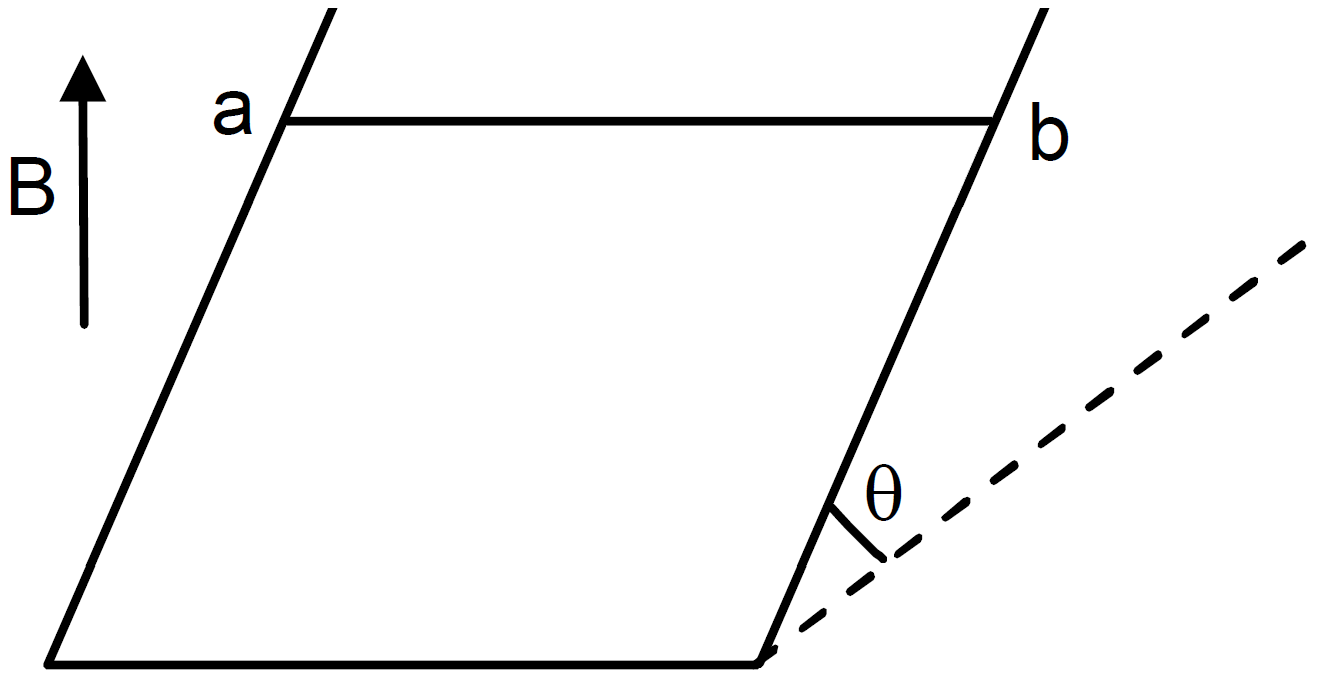
A wire ab of length l, mass m and resistance R slides on a smooth, thick pair of metallic rails joined at the bottom as shown in figure. The plane of the rails makes an angle θ with the horizontal. A vertical magnetic field B exists in the region. If the wire slides on the rails at a constant speed v, show that $\text{B}=\sqrt{\frac{\text{mgR}\sin\theta}{\text{vl}^2\cos^2\theta}}$
Define various types of magnetism on the basis of atomic model of magnetisation.
A long cylindrical wire carries a positive charge of linear density $2.0 \times 10^{-8}Cm^{-1}.$ An electron revolves around it in a circular path under the influence of the attractive electrostatic force. Find the kinetic energy of the electron. Note that it is independent of the radius.
One morning an old man walked bare-foot to replace the fuse wire in kit kat fitted with the power supply mains for his house. Suddenly he screamed and collapsed on the floor. His wife cried loudly for help. His neighbour’s son Anil heard the cries and rushed to the place with shoes on. He took a wooden baton and used it to switch off the main supply.
Answer the following questions:
  1. What is the voltage and frequency of mains supply in India?
  2. These days most of the electrical devices we use require a.c. voltage. Why?
  3. Can a transformer be used to step up d.c.voltage?
  4. Write two qualities displayed by Anil by his action.
During a thunderstorm the ‘live' wire of the transmission line fell down on the ground. A group of boys passing through noticed it and some of them wanted to place the wire by the side. As they were approaching the wire and trying to lift it, Bari noticed it and immediately pushed them away to prevent them from touching the wire. Two of them got hunt in the process. Bari took them to a doctor to get medical aid.
Based on the above paragraph, answer the following:
  1. Write two values which Bari displayed during the incident.
  2. Why is it that a bird can sit over a suspended ‘live' wire without any harm whereas touching it on the ground can give a fatal shock?
  3. The electric power from a power plant is set up to a very high voltage before transmitting it to distant consumers. Write the reason for it.
What are circular and elliptically polarized light?
Two point charges $q_A = 3 \mu\ C$ and $q_B = –3$ μC are located 20 cm apart in vaccum.
  1. What is the electric field at the midpoint O of the line AB joining the two charges?
  2. If a negative test charge of magnitude $1.5 \times 10^{-9}$ C is placed at this point, what is the force experienced by the test charge?
Find the minimum colatitude which can directly receive a signal from a geostationary satellite.