Question
A horizontal cesium plate ($\phi$ = l.9 eV) is moved vertically downward at a constant speed u in a room full of radiation of wavelength 250 run and above. What should be the minimum value of u so that the vertically upward component of velocity is nonpositive for each photoelectron?
Answer

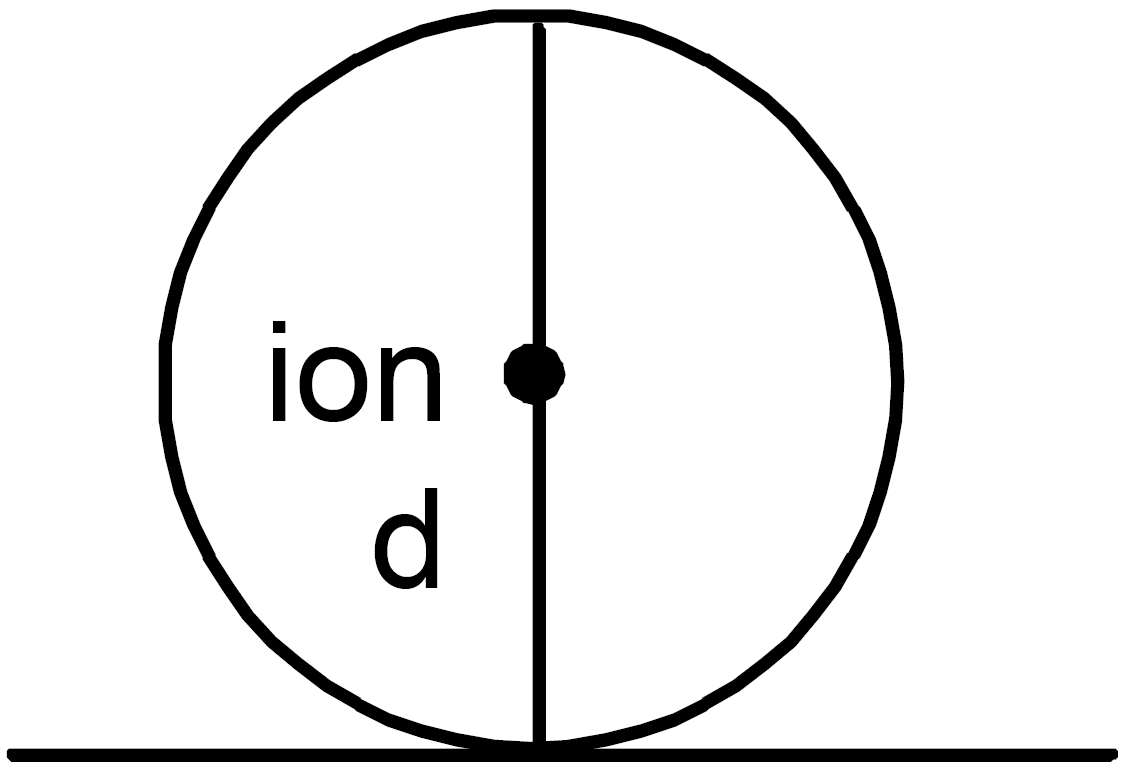
Work function $=\phi,$ distance = d

The particle will move in a circle

When the stopping potential is equal to the potential due to the singly charged ion at that point.

$\text{eV}_0=\frac{\text{hc}}{\lambda}-\phi$

$\Rightarrow\text{v}_0=\Big(\frac{\text{hv}}{\lambda}-\phi\Big)\frac{1}{\text{e}}$

$\Rightarrow\frac{\text{ke}}{2\text{d}}=\Big(\frac{\text{hc}}{\lambda}-\phi\Big)\frac{1}{\text{e}}$

$\Rightarrow\frac{\text{ke}}{\text{2d}}=\frac{\text{hc}}{\lambda}-\phi$

$\Rightarrow\frac{\text{hc}}{\lambda}=\frac{\text{ke}^2}{2\text{d}}+\phi=\frac{\text{ke}^2+2\text{d}\phi}{2\text{d}}$

$\Rightarrow\lambda=\frac{\text{hc 2d}}{\text{ke}^2+2\text{d}\phi}=\frac{2\text{hcd}}{\frac{1}{4\pi\omega_0\text{e}^2}2\text{d}\phi}=\frac{8\pi\omega_0\text{hcd}}{\text{e}^2+8\pi\omega_0\text{d}\phi}$

Need a full question paper?

Generate a complete, print-ready paper with questions like this in minutes — across 16+ boards, with answer keys.

Start Generating Free

Similar questions

In a plane electromagnetic wave, the electric field oscillates sinusoidally at a frequency of 2.0 × 10¹⁰ Hz and amplitude 48 V m-1.
  1. What is the wavelength of the wave?
  2. What is the amplitude of the oscillating magnetic field?
  3. Show that the average energy density of the E field equals the average energy density of the B field. [c = 3 × 10⁸ m s-1.]
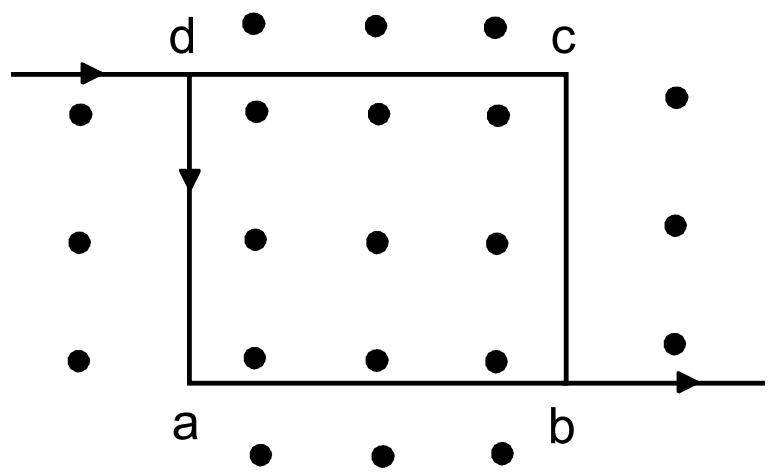
A current of 2A enters at the corner d of a square frame abcd of side 20cm and leaves at the opposite corner b. A magnetic field B = 0.1 T exists in the space in a direction perpendicular to the plane of the frame, as shown in the figure. Find the magnitude and direction of the magnetic forces on the four sides of the frame.

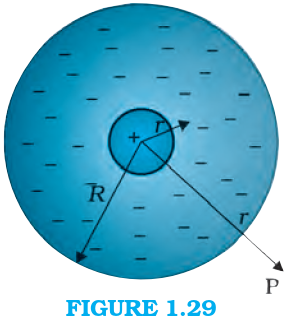
An early model for an atom considered it to have a positively charged point nucleus of charge $Z e$, surrounded by a uniform density of negative charge up to a radius $R$. The atom as a whole is neutral. For this model, what is the electric field at a distance $r$ from the nucleus?
Image
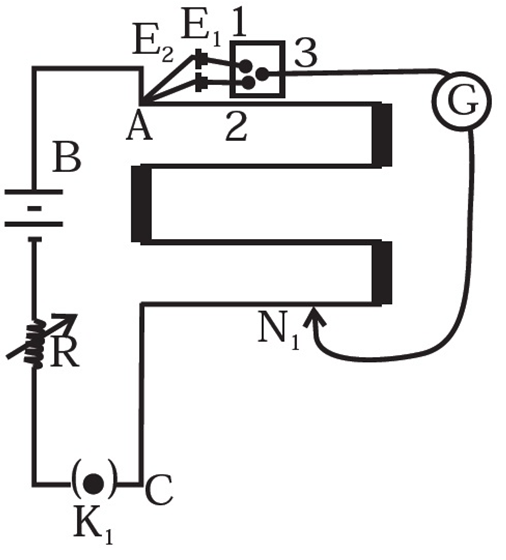
In an experiment with a potentiometer, VB = 10V. R is adjusted to be 50Ω (Fig.). A student wanting to measure voltage E1 of a battery (approx. 8V) finds no null point possible. He then diminishes R to 10Ω and is able to locate the null point on the last (4th) segment of the potentiometer. Find the resistance of the potentiometer wire and potential drop per unit length across the wire in the second case.

What will be the energy corresponding to the first excited state of a hydrogen atom if the potential energy of the atom is taken to be 10eV when the electron is widely separated from the proton? Can we still write $\text{E}_\text{n}=\frac{\text{E}_1}{\text{n}^2}?\text{ r}_\text{n}=\text{a}_0\text{n}^2?$ 
A point source emitting alpha particles is placed at a distance of 1m from a counter which records any alpha particle falling on its 1cm2 window. If the source contains 6.0 × 10¹⁶ active nuclei and the counter records a rate of 50000 counts/ second, find the decay constant. Assume that the source emits alpha particles uniformly in all directions and the alpha particles fall nearly normally on the window.
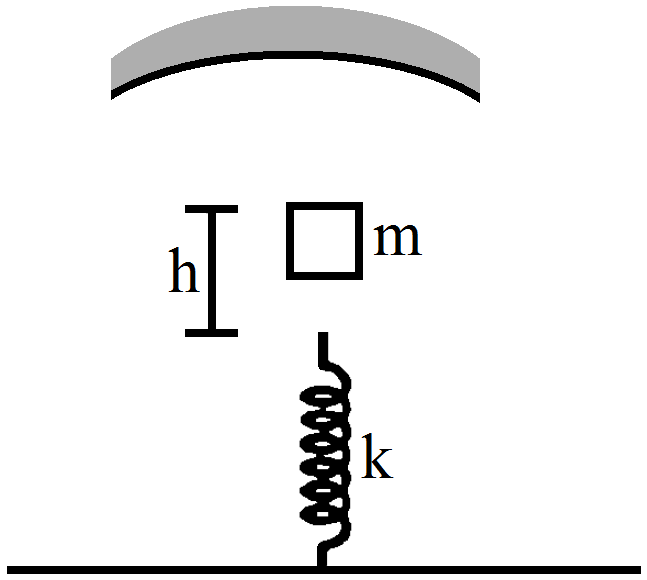
A mass m = 50g is dropped on a vertical spring of spring constant 500N/m from a height h = 10cm as shown in figure. The mass sticks to the spring and executes simple harmonic oscillations after that. A concave mirror of focal length 12cm facing the mass is fixed with its principal axis coinciding with the line of motion of the mass, its pole being at a distance of 30cm from the free end of the spring. Find the length in which the image of the mass oscillates.

Find the speed at which the kinetic enei:gy of a particle will differ by 1% from its nonrelativistic value $\frac{1}{2}\text{m}_0\text{v}^2$
A radio can tune in to any station in the 7.5 MHz to 12 MHz band. What is the corresponding wavelength band?
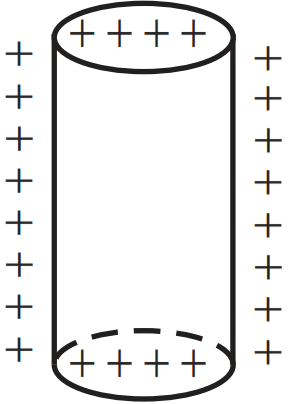
Sketch the electric field lines for a uniformly charged hollow cylinder shown in Fig.