Question
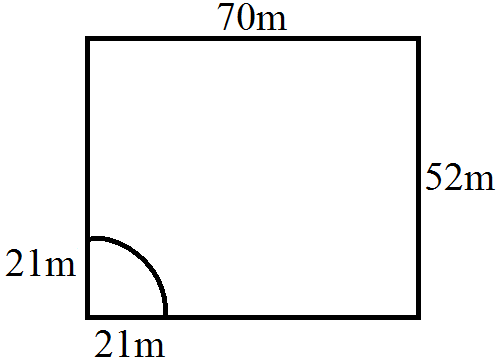
A horse is placed for grazing inside a reangular field $70\ m$ by $2\ m.$ It is tethered to one comer by a rope $21\ m$ long. On how much area an it graze$?$ How much area is left ungrazed? $\Big[\text{Use }\pi=\frac{22}{7}\Big]$
Answer


Area ehich the horse can graze $=$ Area of the quadrant of radius $21\ m$
$=\Big(\frac{1}{4}\times\frac{22}{7}\times21\times21\Big)\text{m}^2$
$=346.5\text{m}^2$
Area ungrazed $=[(70\times52)-346.5]\text{m}^2$
$=3293.5\text{m}^2$

Need a full question paper?

Generate a complete, print-ready paper with questions like this in minutes — across 16+ boards, with answer keys.

Start Generating Free

Similar questions

In $\triangle\text{PQR}, M$ and $N$ are points on sides $PQ$ and $PR$ respectively such that $PM = 15\ cm$ and $NR = 8\ cm$. If $PQ = 25\ cm$ and $PR = 20\ cm$ state whether $MN || QR.$
Give an example of polynomials $f(x), g(x), q(x)$ and $r(x)$ satisfying $f(x) = g(x), q(x) + r(x),$ where degree $r(x) = 0.$
Water is flowing at the rate of $2.52\ km/h$ through a cylindrical pipe into a cylindrical tank, the radius of the base is $40\ cm.$ If the increase in the level of water in the tank, in half an hour is $3.15\ m$, find the internal diameter of the pipe.
The sum of three terms of an $A.P.$ is $21$ and the product of the first and the third terms exceeds the second term by $6,$ find three terms.
A class teacher has the following absentee record of $40$ students of a class for the whole term. Find the mean number of days a student was absent.
Number of days $0-6$ $6-10$ $10-14$ $14-20$ $20-28$ $28-38$ $38-40$
Number of students $11$ $10$ $7$ $4$ $4$ $3$ $1$
If the $HCF$ of $657$ and $963$ is expressible in the form $657x + 963x - 15,$ find $x.$
Find the roots of the following equations, if they exist, by applying the quadratic formula:
$3\text{x}^2-2\sqrt6\text{x}+2=0$
Write all the other trigonometric ratios of $\angle$A in terms of $sec A.$
Find the values of a and b for which the following system of equations has infinitely many solutions:
$2x + 3y - 7 = 0$
$(a - 1)x + (a + 1)y = (3a - 1)$
Is there any value of 'a' for which the equation $x^2+2 x+\left(a^2+1\right)=0$ has real root?