Question
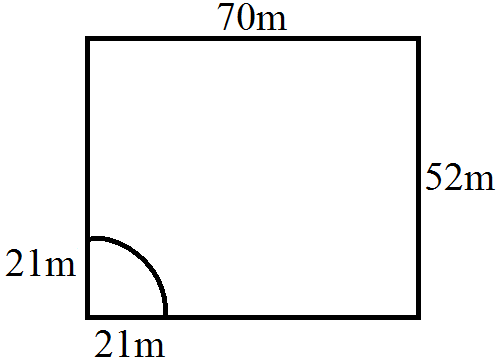
A horse is placed for grazing inside a reangular field 70m by 2m. It is tethered to one comer by a rope 21m long. On how much area an it graze? How much area is left ungrazed? $\Big[\text{Use }\pi=\frac{22}{7}\Big]$
Answer


Area ehich the horse can graze = Area of the quadrant of radius 21m
$=\Big(\frac{1}{4}\times\frac{22}{7}\times21\times21\Big)\text{m}^2$
$=346.5\text{m}^2$
Area ungrazed $=[(70\times52)-346.5]\text{m}^2$
$=3293.5\text{m}^2$

Need a full question paper?

Generate a complete, print-ready paper with questions like this in minutes — across 16+ boards, with answer keys.
Start Generating Free

Similar questions

From a point on the ground, the angles of elevation of the bottom and the top of a transmission tower fixed at the top of a 20 m high building are 45° and 60° respectively. Find the height of the tower
If the sum of first $7$ terms of an $A.P.$ is $49$ and that of first $17$ terms is $289$, find the sum of its first $20$ terms.
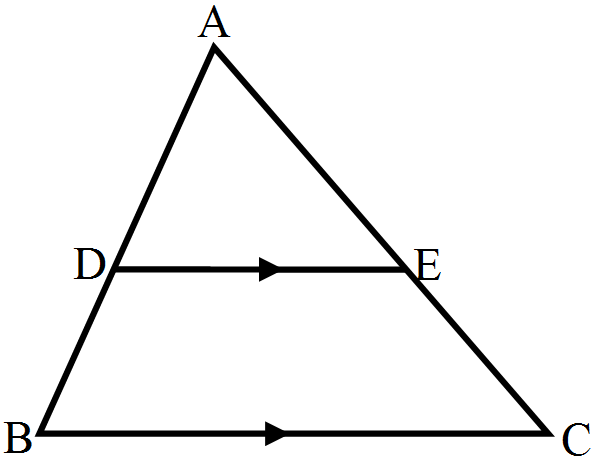
D and E are points on the sides AB and AC respectively of a $\triangle\text{ABC}$ such that DE || BC:
If AD = 3.6cm, AB = 10cm and AE = 4.5cm, find EC and AC.
$500$ persons have to dip in a rectangular tank which is $80\ m$ long and $50\ m$ broad. What is the rise in the level of water in the tank, if the average displacement of water by a person is $0.04m^3?$
All integers from $1$ to $500$ which are multiplies $2$ as well as of $5$.
From the top of a building AB, 60m high, the angles of depression of the top and bottom of a vertical lamp post CD are observed to be 30° and 60° respectively. Find
  1. The horizontal distance between AB and CD.
  2. The height of the lamp post.
  3. The difference between the heights of the building and the lamp post.
Prove that the points A(1, 7), B(4, 2), C(-1, -1) D(-4, 4) are the vertices of a square.
The areas of two similar triangles are $169 cm^2$ and $121 cm^2$ respectively. If the longest side of the larger triangle is $26$ cm , find the longest side of the smaller triangle.
Find the area of $\triangle\text{ABC}$ whose vertices are:
A(10, -6), B(2, 5) and C(-1, 3)
Solve for $x, \frac{1}{x+4}-\frac{1}{x-7}=\frac{11}{30}, x \neq-4,7$.