Question
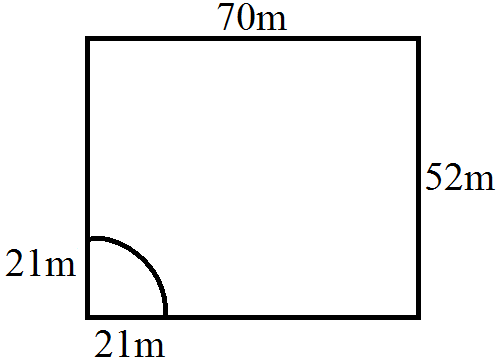
A horse is placed for grazing inside a reangular field 70m by 2m. It is tethered to one comer by a rope 21m long. On how much area an it graze? How much area is left ungrazed? $\Big[\text{Use }\pi=\frac{22}{7}\Big]$
Answer


Area ehich the horse can graze = Area of the quadrant of radius 21m
$=\Big(\frac{1}{4}\times\frac{22}{7}\times21\times21\Big)\text{m}^2$
$=346.5\text{m}^2$
Area ungrazed $=[(70\times52)-346.5]\text{m}^2$
$=3293.5\text{m}^2$

Need a full question paper?

Generate a complete, print-ready paper with questions like this in minutes — across 16+ boards, with answer keys.

Start Generating Free

Similar questions

Walls of two buildings on either side of a street are parellel to each other. A ladder $5.8\ m$ long is placed on the street such that its top just reaches the window of a building at the height of $4\ m$. On turning the ladder over to the other side of the street , its top touches the window of the other building at a height $4.2\ m$. Find the width of the street.
 
A(3, 2) and B(-2, 1) are two vertices of a triangle ABC whose centroid G has the coordinates $\Big(\frac{5}{3},-\frac{1}{3}\Big).$ Find the coordinates of the third vertex C of the triangle.
Solve using formula.
$5 m^2-4 m-2=0$
How many solid cylinders of radius $10 \mathrm{~cm}$ and height $6 \mathrm{~cm}$ can be made by melting a solid sphere of radius $30 \mathrm{~cm}$ ?
Find the value of $k$ so that area of the triangle with triangle with vertices $A(k + 1, 1), B(4, -3)$ and $C(7, -k)$ is $6$ square units.
ABC is a triangle and PQ is a straight line meeting AB in P and AC in Q. If AP = 1cm, PB = 3cm, AQ = 1.5cm, QC = 4.5m, prove that the area of $\triangle\text{APQ}$ is one-sixteenth of the area of $\triangle\text{ABC}.$
A part of monthly hostel charges in a college are fixed and the remaining depend on the number of days one has taken food in the mess. When a student A takes foods for 20 days, he has to pay Rs. 1000 as hostel charges whereas a students B, who takes food for 26 days, pays Rs. 1180 as hostel charges. Find the fixed charge and the cost of food per day.
Solve the following quadratic equations by factorization:
$\text{x}^2-\Big(\sqrt{3}+1\Big)\text{x}+\sqrt{3}=0$
Find the point on the X-axis which is equidistant from A(-3, 4) and B(1, -4).
ABCD is a trapezium in which AB || DC. P and Q are points on sides AD and BC such that PQ || AB. If PD = 18, BQ = 35 and QC = 15, find AD.