MCQ
A hot body will radiate heat most rapidly if its surface is
  • A
    White & polished
  • B
    White & rough
  • C
    Black & polished
  • Black & rough

Answer

Correct option: D.
Black & rough
d
(d)Black and rough surfaces are good absorber that’s why they emit well. (Kirchoff's law).

Need a full question paper?

Generate a complete, print-ready paper with questions like this in minutes — across 16+ boards, with answer keys.

Start Generating Free

Similar questions

In $a$ one-dimensional collision, $a$ particle of mass $2m$ collides with $a$ particle of mass $m$ at rest. If the particles stick together after the collision, what fraction of the initial kinetic energy is lost in the collision?
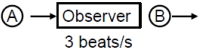
Two sources of sound $S_1$ અને $S_2$ are moving towards and away from a stationary observer with the same speed respectively. Observer detects $3$ beats per second. Find speed of source (approximately). (in $m/s$)

Given, $F 1= F 2=500\, Hz$. speed of air $=330\, m / s$
The maximum range of a gun on horizontal terrain is $16 \,km$. If $g = \;10m/{s^2}$. What must be the muzzle velocity of the shell ......... $m/s$
A ball is bouncing elastically with a speed 1m/s between walls of a railway compartment of size 10m in a direction perpendicular to walls. The train is moving at a constant velocity of 10m/s parallel to the direction of motion of the ball. As seen from the ground,
  1. The direction of motion of the ball changes every 10 seconds.
  2. Speed of ball changes every 10 seconds.
  3. Average speed of ball over any 20 second interval is fixed.
  4. The acceleration of ball is the same as from the train.
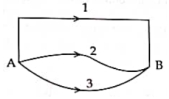
A gravitational field is present in a region and a mass is shifted from $A$ to $B$ through different paths as shown. If $W _1, W _2$ and $W _3$ represent the work done by the gravitational force along the respective paths, then
Two particles of equal mass have velocities $2\,\hat i\, ms^{-1}$ and $2\,\hat j\, ms^{-1}$. First particle has an acceleration $(\,\hat i\, + \,\hat j\,)$ $ms^{-2}$ while the acceleration of the second particle is zero. The centre of mass of the two particles moves in
Spring of spring constant $1200\, Nm^{-1}$ is mounted on a smooth frictionless surface and attached to a block of mass $3\, kg$. Block is pulled $2\, cm$ to the right and released. The angular frequency of oscillation is .... $ rad/sec$
A beaker contains a fluid of density $\rho \, kg / m^3$, specific heat $S\, J / kg\,^oC$ and viscosity $\eta $. The beaker is filled upto height $h$. To estimate the rate of heat transfer per unit area $(Q / A)$ by convection when beaker is put on a hot plate, a student proposes that it should depend on $\eta \,,\,\left( {\frac{{S\Delta \theta }}{h}} \right)$ and $\left( {\frac{1}{{\rho g}}} \right)$ when $\Delta \theta $ (in $^oC$) is the difference in the temperature between the bottom and top of the fluid. In that situation the correct option for $(Q / A)$ is
The maximum possible efficiency of a heat engine is ...........
The apparent coefficient of expansion of a liquid when heated in a brass vessel is $X$ and when heated in a tin vessel is $Y$. If $\alpha$ is the coefficient of linear expansion for brass, the coefficient of linear expansion of tin is ..........