Question
A hydrogen atom contains one proton and one electron. It may be assumed that the electron revolves in a circle of radius 0.53 angstrom (1 angstrom $= 10^{-10}m$ and is abbreviated as A) with the proton at the centre. The hydrogen atom is said to be in the ground state in this case. Find the magnitude of the electric force between the proton and the electron of a hydrogen atom in its ground state.
Answer

$\text{R}=0.53\text{A}^\circ=0.53\times10^{-10}\text{m}$
$\text{F}=\frac{\text{Kq}_1\text{q}_2}{\text{r}^2}$
$=\frac{9\times10^9\times1.6\times1.6\times10^{-38}}{0.53\times0.53\times10^{-10}\times10^{-10}}$
$=82.02\times10^{-9}\text{N}$

Need a full question paper?

Generate a complete, print-ready paper with questions like this in minutes — across 16+ boards, with answer keys.

Start Generating Free

Similar questions

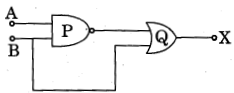
  1. Identify the logic gates marked P and Q in the given logic circuit.
  1. Write down the output at X for the inputs A = 0, B = 0 and A = 1, B = 1.
Two cells of emf 10V and 2V and internal resistance $10\Omega$ and $5\Omega$ respectively, are connected in parallel as shown. Find the effective voltage across R.
A lamp is connected in series with a capacitor. Predict your observations for dc and ac connections. What happens in each case if the capacitance of the capacitor is reduced?
Free electron density of copper is $8.5 \times 10^{28}$ per $m ^3$. Find out the current in copper wire of length 0.1 m and area of cross-section $1 mm^2$ when a battery of 3 V is joined across its ends. (Given mobility of electrons = $4.5 \times 10^{-6} m^2 V^{-1} s^{-1}$, charge on electron, $e=1.6 \times 10^{-19} C$ )
A body rotates about a fixed axis with an angular acceleration of one radian/ second/ second. Through what angle does it rotate during the time in which its angular velocity increases from 5rad/s to 15rad/s.
A spherical conducting shell of inner radius $r_1$ and outer radius $r_2$ has a charge ‘Q’. A charge ‘q’ is placed at the centre of the shell.
  1. What is the surface charge density on the (i) inner surface, (ii) outer surface of the shell?
  2. Write the expression for the electric field at a point $x > r_2$ from the centre of the shell.
Explain the formation of the barrier potential in a p-n junction.
Can you add two vectors representing physical quantities having different dimensions? Can you multiply two vectors representing physical quantities having different dimensions?
Explain : "Electric charges are additive in nature."
Draw a graph between photoelectric current and anode potential for two light beams of different intensity and same wavelength.