MCQ
A hydrogen electrode is immersed in a solution with $pH = 0\,(HCl)$. By how much will the potential (reduction) change if an equivalent amount of $NaOH$ is added to the solution.

(Take $pH_2 = 1\,atm$ ), $T = 298\,K$.

  • A
    increase by $0.41\,V$
  • B
    increase by $59\,mV$
  • decrease by $0.41\,V$
  • D
    decrease by $59\,mV$

Answer

Correct option: C.
decrease by $0.41\,V$
c
$pH$ changes from $0$ to $7$.

$\therefore $  $[H^+]$  changes from $1$ to $10^{-7}\,M$

Accordingly ${{E}_{red.}}=\,\frac{-\,0.059}{n}\,\log \,\frac{1}{[{{H}^{+}}]}$

                             $ = \,0.059\,\,\log \,{10^{ - 7}}$

i.e., $0.059\times (-7)\,=\,-0.41\,volts$

Need a full question paper?

Generate a complete, print-ready paper with questions like this in minutes — across 16+ boards, with answer keys.

Start Generating Free

Similar questions

In the given reaction

$\begin{array}{*{20}{c}}
  {C{H_3} - CH - C{H_2} - C{H_2} - CH - C{H_3}} \\ 
  {|\,\,\,\,\,\,\,\,\,\,\,\,\,\,\,\,\,\,\,\,\,\,\,\,\,\,\,\,\,\,\,\,\,\,\,\,\,\,\,\,\,\,\,\,\,\,\,\,\,\,\,\,\,|\,\,\,\,\,} \\ 
  {\,\,OTs\,\,\,\,\,\,\,\,\,\,\,\,\,\,\,\,\,\,\,\,\,\,\,\,\,\,\,\,\,\,\,\,\,\,\,\,\,\,\,\,\,\,\,\,OTs} 
\end{array}\xrightarrow[{(ii)\,KOH}]{{(i)\mathop {\,S}\limits^ \ominus  H\,(one\,\,equivalent)}}[X]$

$[X]$ will be :

Ethylene may be obtained by dehydration of which of the following with concentrated ${H_2}S{O_4}$ at $160 - {170\,^o}C$
The rate of first order reaction is $0.04 \mathrm{~mol} \mathrm{~L}^{-1} \mathrm{~s}^{-1}$ at $10$ minutes and $0.03 \mathrm{~mol} \mathrm{~L}^{-1} \mathrm{~s}^{-1}$ at $20$ minutes after initiation. Half life of the reaction is ____________minutes. (Given $\log 2=0.3010, \log 3=0.4771)$
In the manufacture of sulphuric acid by contact process, Tyndall box is used to
An organic compound $P$ having molecular formula $C _6 H _6 O _3$ gives ferric chloride test and does not have intramolecular hydrogen bond. The compound $P$ reacts with $3$ equivalents of $NH _2 OH$ to produce oxime $Q$. Treatment of $P$ with excess methyl iodide in the presence of $KOH$ produces compound $R$ as the major product. Reaction of $R$ with excess iso-butylmagnesium bromide followed by treatment with $H _3 O ^{+}$gives compound $S$ as the major product.

The total number of methyl $\left(- CH _3\right)$ group($s$) in compound $S$ is. . . . 

$pOH$ of water is $7.0$ at $298\,K$ . If water is heated to $350\,K$ , which of the following should be true?
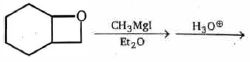
What is the major product of the following reaction ?
Which of the following compounds will react with $Na$ to form $4,5-$ diethyloctane ?
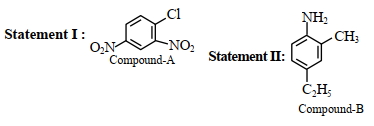
Given below are two statements:

(Image)

$IUPAC$ name of Compound $A$ is $4-$ chloro-$1$, $3$-dinitrobenzene:

(Image)

$IUPAC$ name of Compound $B$ is

$4$-ethyl-$2$-methylaniline.

In the light of the above statements, choose the most appropriate answer from the options given below:

With oxalic acid, glycerol at ${260\,^o}C$ gives