Question
(a) In Example 3.1, the electron drift speed is estimated to be only a few $mm s ^{-1}$ for currents in the range of a few amperes? How then is current established almost the instant a circuit is closed?
(b) The electron drift arises due to the force experienced by electrons in the electric field inside the conductor. But force should cause acceleration. Why then do the electrons acquire a steady average drift speed?
(c) If the electron drift speed is so small, and the electron's charge is small, how can we still obtain large amounts of current in a conductor?
(d) When electrons drift in a metal from lower to higher potential, does it mean that all the 'free' electrons of the metal are moving in the same direction?
(e) Are the paths of electrons straight lines between successive collisions (with the positive ions of the metal) in the (i) absence of electric field, (ii) presence of electric field?
Answer

(a) Electric field is established throughout the circuit, almost instantly (with the speed of light) causing at every point a local electron drift. Establishment of a current does not have to wait for electrons from one end of the conductor travelling to the other end. However, it does take a little while for the current to reach its steady value.
(b) Each 'free' electron does accelerate, increasing its drift speed until it collides with a positive ion of the metal. It loses its drift speed after collision but starts to accelerate and increases its drift speed again only to suffer a collision again and so on. On the average, therefore, electrons acquire only a drift speed.
(c) Simple, because the electron number density is enormous, $\sim 10^{29} m ^{-3}$.
(d) By no means. The drift velocity is superposed over the large random velocities of electrons.
(e) In the absence of electric field, the paths are straight lines; in the presence of electric field, the paths are, in general, curved.

Need a full question paper?

Generate a complete, print-ready paper with questions like this in minutes — across 16+ boards, with answer keys.

Start Generating Free

Similar questions

  1. Define the term ‘conductivity’ of a metallic wire. Write its SI unit.
  2. Using the concept of free electrons in a conductor, derive the expression for the conductivity of a wire in terms of number density and relaxation time. Hence obtain the relation between current density and the applied electric field E.
  1. Two cells of emf $E_1$ and $E_2$ have their internal resistances $r_1$ and $r_2$, respectively. Deduce an expression for the equivalent emf and internal resistance of their parallel combination when connected across an external resistance $R.$ Assume that the two cells are supporting each other.
  2. In case the two cells are identical, each of emf $E = 5V$ and internal resistance $\text{r}=2\Omega,$ calculate the voltage across the external resistance $\text{R}=10\Omega.$
A person has near point at 100cm. What power of lens is needed to read at 20cm if he/ she uses.
  1. Contact lens,
  2. Spectacles having glasses 2.0cm separated from the eyes?
A 10 m long wire of uniform cross-section and 20 $\Omega$ resistance is used in a potentiometer. The wire is connected in series with a battery of 5V along with an external resistance of 480 $\Omega$. If an unknown emf E is balanced at 6.0 m length of the wire, calculate:
  1. The potential gradient of the potentiometer wire.
  2. The value of unknown emf  E.
The magnetic field of a beam emerging from a filter facing a floodlight is given by $B_0 = 12 \times 10^{-8}\sin (1.20 \times 10^7z - 3.60 \times 10^{15}t) T.$ What is the average intensity of the beam?
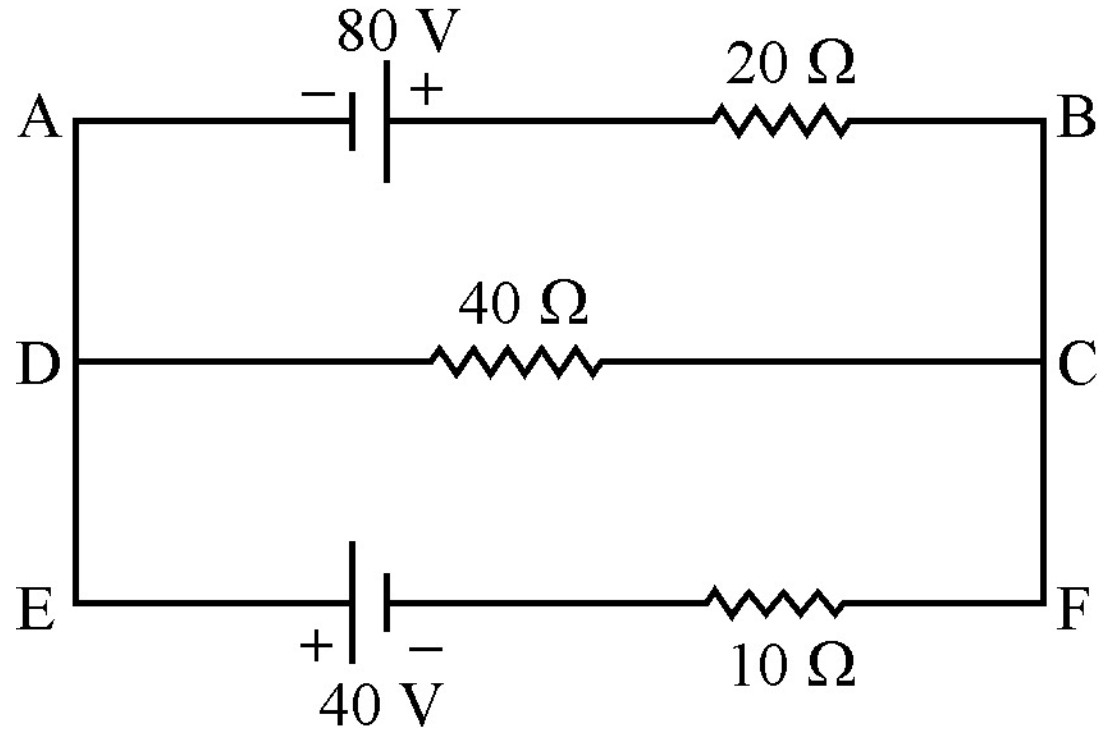
Using Kirchhoff’s rules, calculate the current through the $40\Omega$ and $20\Omega$ resistors in the following circuit:
State the law of radioactive decay.
Plot a graph showing the number $(N)$ of undecayed nuclei as a function of time $(t)$ for a given radioactive sample having half life $T_\frac12.$
Depict in the plot the number of undecayed nuclei at $(i) t = 3 T_\frac12$ and $(ii) t = 5 T_\frac12.$
What are reflecting type of telescope ? Explain the advantages and disadvantages of reflecting telescopes as compared to refracting telescope and also give the solution.
A parallel plate capacitor with air between its plates has a capacitance of 8 pF(1 pF = 10-12F) . What will be the capacitance if the distance between the plates is reduced by half, and the space between them is filled with a substance of dielectric constant 6?
Photoelectrons are emitted from a metal surface when illuminated with $UV$ light of wavelength $330 nm$ . The minimum amount of energy required to emit the electrons from the surface is $3.5 \times 10^{-19} J$. Calculate :
$a$. the energy of the incident radiation, and
$b$. the kinetic energy of the photoelectron.