MCQ
A is the fundamental quantity. Here, $A$ refers to:
  • Mass.
  • B
    Velocity.
  • C
    Acceleration.
  • D
    Linear momentum.

Answer

Correct option: A.
Mass.
Mass is the fundamental quantity as it does not depend upon other physical quantities. However, other three quantities, i.e. velocity, acceleration and linear momentum are not fundamental quantities as these show their dependency on fundamental quantities.

Need a full question paper?

Generate a complete, print-ready paper with questions like this in minutes — across 16+ boards, with answer keys.
Start Generating Free

Similar questions

The rate of recombination or generation are governed by the law(s) of
$50$ tuning forks are arranged in increasing order of their frequencies such that each gives $4 \,beats/sec$ with its previous tuning fork. If the frequency of the last fork is octave of the first, then the frequency of the first tuning fork is  ... $Hz$
An engine whistling at a constant frequency $n_0$ and moving with a constant velocity goes past a stationary observer. As the engine crosses him, the frequency of the sound heard by him changes by a factor $f$. The actual difference in the frequencies of the sound heard by him before and after the engine crosses him is 
The displacement of a particle is given by $y = 5 \times {10^{ - 4}}\sin (100t - 50x)$, where $x$ is in meter and $t$ in sec, find out the velocity of the wave  .... $m/sec$
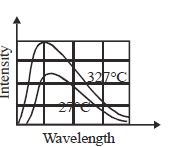
The spectrum of a black body at two temperatures $27\,^oC$ and $327\,^oC$ is shown in the figure. Let $A_1$ and $A_2$ be the areas under the two curves respectively. Find the value of $\frac {A_2}{A_1}$
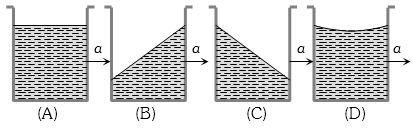
A vessel containing water is given a constant acceleration a towards the right, along a straight horizontal path. Which of the following diagram represents the surface of the liquid
Mass of moon is $7.34 \times {10^{22}}\,kg$. If the acceleration due to gravity on the moon is $1.4\,m/{s^2}$, the radius of the moon is $(G = 6.667 \times {10^{ - 11}}\,N{m^2}/k{g^2})$
Which of the following is true for a satellite in an orbit?
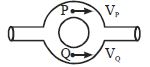
In the figure shown, a liquid is flowing through a tube at the rate of $0.1\, m^3/sec$. The tube is branched into two semicircular tubes of cross-sectional area $A/3$ and $2A/3$. The velocity of liquid at $Q$ is ......... $ m/sec$ (The cross-section of the main tube $= A =10^{-2}\, m^2$ and $v_p = 20\, m/sec$)
A particle of mass $1\,kg$ is moving along $x-$ axis, where its velocity depends on $x-$ coordinate as $v = 2\sqrt x \,(m/s)$. Find the net force acting on the particle $2\,second$ after the start of motion ............ $N$