MCQ
A is the fundamental quantity. Here, A refers to:
  • A
    Mass.
  • B
    Velocity.
  • C
    Acceleration.
  • D
    Linear momentum.

Answer

  1. Mass.

Explanation:

Mass is the fundamental quantity as it does not depend upon other physical quantities. However, other three quantities, i.e. velocity, acceleration and linear momentum are not fundamental quantities as these show their dependency on fundamental quantities.

Need a full question paper?

Generate a complete, print-ready paper with questions like this in minutes — across 16+ boards, with answer keys.
Start Generating Free

Similar questions

Which graph represents the variation of surface tension with temperature over small temperature ranges for water
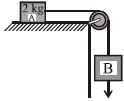
The coefficient of static friction, $\mu _s$ between block $A$ of mass $2\,kg$ and the table as shown in the figure is $0.2$. What would be the maximum mass value of block $B$ so that the two blocks $B$ so that the two blocks do not move? The string and the pulley are assumed to be smooth and masseless ....... $kg$ $(g = 10\,m/s^2)$
A liquid is coming out from a vertical tube. The relation between the weight of the drop $W$, surface tension of the liquid $T$ and radius of the tube $r$ is given by, if the angle of contact is zero
Which thermodynamic property do systems have in comman when they are in thermal equilibrium?
Which of the following expression does not represent simple harmonic motion?
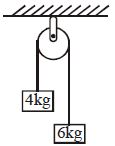
For the pulley system the kinetic energy of the $6\,kg$ block after $5\,s$ is ............ $\mathrm{J}$
Young’s modulus of perfectly rigid body material is
The potential energy of a certain particle is given by $U = \frac{1}{2}\,\left( {{x^2} - {z^2}} \right)$. The force on it is 
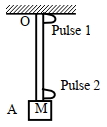
A block $\mathrm{M}$ hangs vertically at the bottom end of a uniform rope of constant mass per unit length. The top end of the rope is attached to a fixed rigid support at $O$. A transverse wave pulse (Pulse $1$ ) of wavelength $\lambda_0$ is produced at point $O$ on the rope. The pulse takes time $T_{O A}$ to reach point $A$. If the wave pulse of wavelength $\lambda_0$ is produced at point $A$ (Pulse $2$) without disturbing the position of $M$ it takes time $T_{A 0}$ to reach point $O$. Which of the following options is/are correct?

(image)

[$A$] The time $\mathrm{T}_{A 0}=\mathrm{T}_{\mathrm{OA}}$

[$B$] The velocities of the two pulses (Pulse $1$ and Pulse $2$) are the same at the midpoint of rope.

[$C$] The wavelength of Pulse $1$ becomes longer when it reaches point $A$.

[$D$] The velocity of any pulse along the rope is independent of its frequency and wavelength.
A passenger train of length $60\, m$ travels at a speed of $80\, km/hr$. Another freight train of length $120\, m$ travels at a speed of $30\, km/hr$. The ratio of times taken by the passenger train to completely cross the freight train when:

$(i)$ they are moving in the same direction, and

$(ii)$ in the opposite directions is