Question
A lamp is connected in series with a capacitor. Predict your observations for dc and ac connections. What happens in each case if the capacitance of the capacitor is reduced?

Answer

When a de source is connected to a capacitor, the capacitor gets charged and after charging no current flows in the circuit and the lamp will not glow. There will be no change even if $C$ is reduced. With ac source, the capacitor offers capacitative reactance $(1 / \omega C)$ and the current flows in the circuit. Consequently, the lamp will shine. Reducing $C$ will increase reactance and the lamp will shine less brightly than before.

Need a full question paper?

Generate a complete, print-ready paper with questions like this in minutes — across 16+ boards, with answer keys.
Start Generating Free

Similar questions

On a hot summer day we want to cool our room by opening the refrigerator door and closing all the windows and doors. Will the process work ?
What facts are obtained by the scattering with angle more than $90^{\circ}$.
Draw 3 equipotential surfaces corresponding to a field that uniformly increases in magnitude but remains constant along Z-direction. How are these surfaces different from that of a constant electric field along Z-direction?
A and B are two conducting spheres of equal radius, in which sphere $A$ is solid and sphere $B$ is hollow. Both are charged to the same potential. What will be the relation between the charges on both the spheres?
An electroplating unit plates 3.0g of silver on a brass plate in 3.0 minutes. Find the current used by the unit. The electrochemical equivalent of silver is 1.12 × 10-6 kg C-1.
A boy is standing on a platform which is free to rotate about its axis. The boy holds an open umbrella in his hand. The axis of the umbrella coincides with that of the platform. The moment of inertia of ''the platform plus the boy system'' is 3.0 × 10⁻³kg-m2 and that of the umbrella is 2.0 × 10³kg-m2. The boy starts spinning the umbrella about the axis at an angular speed of 2.0rev/s with respect to himself. Find the angular velocity imparted to the platform.
Explain destructive interference using proper (appropriate) example.
Is it necessary to have two waves of equal intensity to study interference pattern? Will there be an effect on clarity if the waves have unequal intensity?
Using Bohr’s atomic model, derive the expression for the radius of nth orbit of the revolving electron in a hydrogen atom.
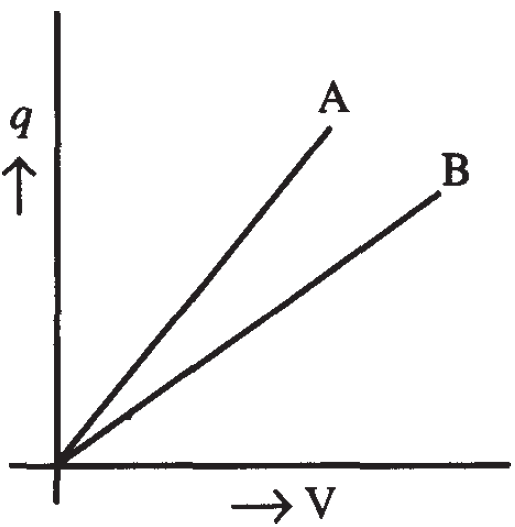
The given graph shows the variation of charge q versus potential difference V for two capacitors C1 and C2. The two capacitors have same plate separation, but the plate area of C2 is double than that of C1. Which of the lines in the graph correspond to C1 and C2 and why?