MCQ
A large nonconducting sheet M is given a uniform charge density. Two uncharged small metal rods A and B are placed near the sheet as shown in figure:
- AM attracts A.
- BM attracts B.
- CA attracts B.
- DB attracts A.
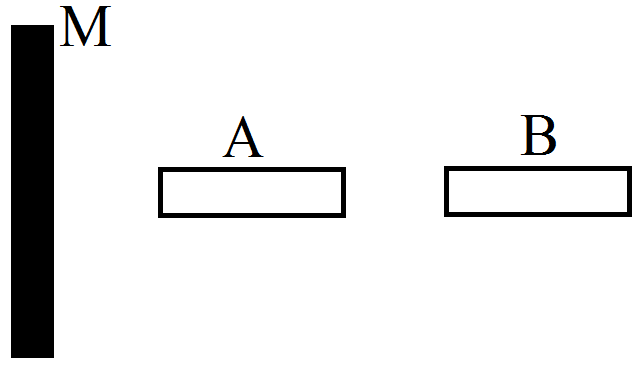
Explanation:
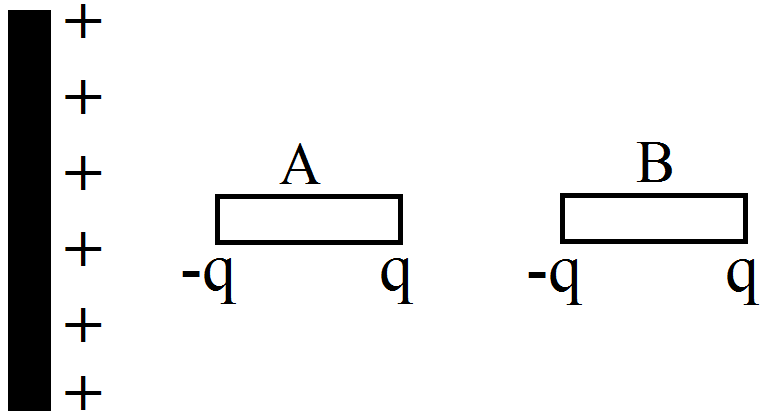
Charge distribution or M, A & B
So, we can say that M attracts A, M attracts B, A attracts B and 'B' attracts A.
Generate a complete, print-ready paper with questions like this in minutes — across 16+ boards, with answer keys.
Assertion : The colour of the green flower seen through red glass appears to be dark.
Reason : Red glass transmits only red light.
|
(a) If both assertion and reason are true and the reason is the correct explanation of the assertion. |
|
(b) If both assertion and reason are true but reason is not the correct explanation of the assertion. |
|
(c) If assertion is true but reason is false. |
|
(d) If the assertion and reason both are false. |
The attenuation in optical fibre is mainly due to
|
(a) Absorption |
(b) Scattering |
|
(c) Neither absorption nor scattering |
(d) Both (a) and (b) |
In a PNP transistor the base is the N-region. Its width relative to the P-region is
|
(a) Smaller |
(b) Larger |
(c) Same |
(d) Not related |
The potential barrier, in the depletion layer, is due to
|
(a) Ions |
(b) Holes |
(c) Electrons |
(d) Both (b) and (c) |
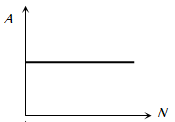
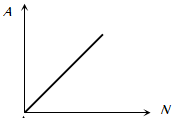
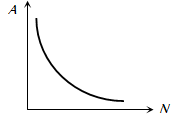
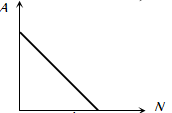
The curve between the activity A of a radioactive sample and the number of active atoms N is
|
(a)
|
(b)
|
(c)
|
(d)
|