MCQ
A lift is moving downwards with an acceleration equal to acceleration due to gravity. A body of mass $m$ kept on the floor of the lift is pulled horizontally. If the coefficient of friction is $\,\mu $, then the frictional resistance offered by the body is
  • A
    $mg$
  • B
    $\mu mg$
  • C
    $2\mu mg$
  • Zero

Answer

Correct option: D.
Zero
d
(d) $(N=\text { normal, } m=\text { mass of object, } a=$ acceleration of lift)

$m g-N=m a$

$N=m a-m g$

$(\text { given } a=g)$

therefore $N=0$

friction $=u . N$

hence friction $=u .0(\mathrm{N}=0)$

$=0$

Need a full question paper?

Generate a complete, print-ready paper with questions like this in minutes — across 16+ boards, with answer keys.

Start Generating Free

Similar questions

The displacement y of a particle in a medium can be expressed as: $y = {10^{ - 6}}\sin (100t + 20x + \pi /4)m,$ where $t$ is in second and $x$ in meter. The speed of wave is ... $m/s$
Mark the correct statement :-
An open water tight railway wagon of mass $5 \times 10^3 kg$ coasts at an initial velocity $1.2 m/s$ without friction on a railway track. Rain drops fall vertically downwards into the wagon. The velocity of the wagon after it has collected $10^3 kg$ of water will be .............. $\mathrm{m}/ \mathrm{s}$
When a ceiling fan is switched off its angular velocity reduces to $50\%$ while it makes $ 36$ rotations. How many more rotation will it make before coming to rest (Assume uniform angular retardation)
Let a wire be suspended from the ceiling (rigid support) and stretched by a weight $W$ attached at its free end. The longitudinal stress at any point of cross-sectional area $A$ of the wire is :
Which of the following is not the unit of time
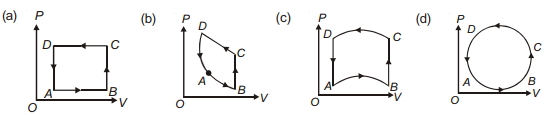
In following figures $(a)$ to $(d)$, variation of volume by change of pressure is shown in figure. The gas is taken along the path $A B C D A$. Change in internal energy of the gas will be .......
If the equation for the displacement of a particle moving on a circular path is given as

$\theta  = 2{t^3} + 0.5,$

where $\theta $ is in radians and $t$ is in second. Then the angular velocity of the particle after two second will be ....... $rad/sec$

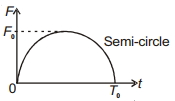
The magnitude of force acting on a particle moving along $x$-axis varies with time $(t)$ as shown in figure. If at $t=0$ the velocity of particle is $v_0$, then its velocity at $t=T_0$ will be
For a black body at temperature $727^{\circ} C$, its radiating power is $60\; watt$ and temperature of surrounding is $227^{\circ} C$. If temperature of black body is changed to $1227^{\circ} C$ then its radiating power will be ..... $watt$