MCQ
A light has amplitude $A$ and angle between analyser and polariser is $60^\circ $. Light is reflected by analyser has amplitude
  • A
    $\mathrm{A}^{\sqrt{2}}$
  • B
    $\mathrm{Al}^{\sqrt{2}}$
  • C
    ${ }^{\sqrt{3}} \frac{~A}{2}$
  • $\frac{A}{2}$

Answer

Correct option: D.
$\frac{A}{2}$
$\frac{A}{2}$

Need a full question paper?

Generate a complete, print-ready paper with questions like this in minutes — across 16+ boards, with answer keys.
Start Generating Free

Similar questions

A capacitor $4\ \mu F$ charged to $50 V$ is connected to another capacitor of $2\ \mu F$ charged to $100 V$ with plates of like charges connected together. The total energy before and after connection in multiples of $(10^{-2} J)$ is
According to Wien's displacement law in relation to radiation the wavelength $ \lambda_{m} $ corresponding to minimum radiant energy and absolute temperature T are related as :
S.I. unit of magnetic moment is :
We use flint glass prism to disperse polychromatic light because light of different colours(a) Travel with same speed(b) Travel with same speed but deviate differently due to the shape of the prism(c) Have different anisotropic properties while travelling through the prism(d) Travel with different speeds


A current $I$ is passed for a time $t$ through a number of voltameters. If $m$ is the mass of a substance deposited on an electrode and $z$ is its electrochemical equivalent, then
Metals getting magnetised by orientation of atomic magnetic moments in external magnetic field are called:
To get an output Y=1 from the circuit above, the input must be:
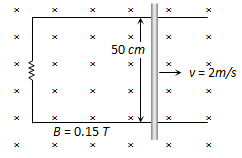
As shown in the figure a metal rod makes contact and complete the circuit. The circuit is perpendicular to the magnetic field with $B = 0.15$ tesla. If the resistance is $3Ω,$ force needed to move the rod as indicated with a constant speed of $2m/\sec$  is
When an atomic gas or vapour is excited at low pressure, by passing an electric current through it then?
According to Bohr hypothesis, discrete quantity is: