MCQ
A light has amplitude $A$ and angle between analyser and polariser is $ 60^o .$  Light is reflected by analyser has amplitude
  • A
    $A\sqrt 2 $
  • B
    $A/\sqrt 2 $
  • C
    $\sqrt 3 A/2$
  • $A/2$

Answer

Correct option: D.
$A/2$
d
(d)The amplitude will be$A\cos {60^o} = A/2$

Need a full question paper?

Generate a complete, print-ready paper with questions like this in minutes — across 16+ boards, with answer keys.
Start Generating Free

Similar questions

A solid sphere rolls down an inclined plane and its velocity at the bottom is $v_1$. Then same sphere slides down the plane (without friction) and let its velocity at the bottom be $v_2$. Which of the following relation is correct 
The potential difference in open circuit for a cell is $2.2\, volts$. When a $4\, ohm$ resistor is connected between its two electrodes the potential difference becomes $2\, volts$. The internal resistance of the cell will be .............. $ohm$
Which of the following pairs of physical quantities has the same dimensions
In a diode valve the cathode temperature must be ($\phi$ = work function)
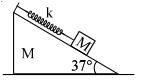
The system of the wedge and the block connected by a massless spring as shown in the figure is released with the spring in its natural length. Friction is absent. maximum elongation in the spring will be
Frosted glass is widely used for translucent windows. The region, where a transparent adhesive tape is stuck over the frosted glass becomes transparent. The most reasonable explanation for this is
The image of an object placed in air formed by a convex refracting surface is at a distance of $10\, m$ behind the surface. The image is real and is at $\frac{2}{3}$ of the distance of the object from the surface . The wavelength of light inside the surface is $\frac{2}{3}$ times the wavelength in air. The radius of the curved surface is $\frac{ x }{13}\, m$. the value of $^{\prime} x^{\prime}$ is ....... .
Consider a photon of continuous $X-$ ray and a photon of characteristics $X-$ ray of the same wavelength. Which of the following is different for the two photons
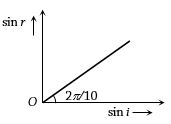
The graph between sine of angle of refraction $(sin\, r)$ in medium $2$ and sine of angle of incidence $(sin\, i)$ in medium $1$ indicates that ($tan 36^o $ $\approx$ $\frac{3}{4}$)
Four particles, each of mass $M$ and equidistant from each other, move along a circle of radius $R$ under the action of their mutual gravitational attraction. The speed of each particle is