MCQ
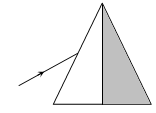
A light ray is incident upon a prism in minimum deviation position and suffers a deviation of $34^\circ .$ If the shaded half of the prism is knocked off, the ray will
  • A
    Suffer a deviation of $34^{\circ}$
  • B
    Suffer a deviation of $68^{\circ}$
  • Suffer a deviation of $17^{\circ}$
  • D
    Not come out of the prism

Answer

Correct option: C.
Suffer a deviation of $17^{\circ}$

Need a full question paper?

Generate a complete, print-ready paper with questions like this in minutes — across 16+ boards, with answer keys.

Start Generating Free

Similar questions

An LCR series circuit with $100\Omega$ resistance is connected to an ac source of 200V and of frequency of $\frac{300 \text{rad}}{\text{s}}$. When only the capacitance is removed, the current lags behind the voltage by 600. When only the inductance is removed, the current leads the voltage by 60° the current through the circuit is:
If a positive charge is shifted from a low-potential region to a high-potential region, the electric potential energy.
  1. Increases.
  2. Decreases.
  3. Remains the same.
  4. May increase or decrease.
A dielectric slab is inserted between the plates of an isolated capacitor. The force between the plates will:
The graph of ln$\Big(\frac{\text{R}}{\text{R}_{\text{0}}}\Big)$ versus In A (R = radius of a nucleus and A - its mass number) is:
  1. A straight line.
  2. A parabola.
  3. An ellipse.
  4. None of them.
If cathode rays are projected at right angles to a magnetic field, their trajectory is (a) Ellipse(b) Circle(c) Parabola(d) None of these
       
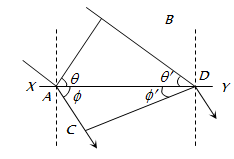
In the adjoining diagram, a wavefront $AB,$ moving in air is incident on a plane glass surface $XY.$ Its position $CD$ after refraction through a glass slab is shown also along with the normals drawn at $A$ and $D.$ The refractive index of glass with respect to air $(\mu = 1)$ will be equal to
A star emits light of 5500 Å wavelength. Its appears blue to an observer on the earth, it means(a) Star is going away from the earth(b) Star is stationary(c) Star is coming towards earth(d) None of the above
   
   
The value of electric potential of a distance $r$ from a point charge $q$ is :
The time required to pass the light through a glass slab of $2$ mm thick is $\left(\mu_{\text {glass }}=1.5\right)$
Which one of the following is more monocromatic?