MCQ
A light source of wavelength $\lambda$ illuminates a metal surface and electrons are ejected with maximum kinetic energy of 2 eV . If the same surface is illuminated by a light source of wavelength $\frac{\lambda}{2}$, then the maximum kinetic energy of ejected electrons will be (The work function of metal is 1 eV )
  • A
    2 eV
  • B
    6 eV
  • 5 eV
  • D
    3 eV

Answer

Correct option: C.
5 eV
(C) 5 eV
$ \begin{array}{l} \frac{hc}{\lambda}=\phi+eV \Rightarrow \frac{hc}{\lambda}=1+2=3 eV \ldots(1)\\ \frac{hc}{\lambda / 2}=6=1+k_{\max } \therefore k_{\max }=5 eV \end{array} $

Need a full question paper?

Generate a complete, print-ready paper with questions like this in minutes — across 16+ boards, with answer keys.

Start Generating Free

Similar questions

If $v = x^2 -5x + 4$, find the acceleration of particle when velocity of the particle is zero
An earthquake generates both transverse $(S)$ and longitudinal $(P)$ sound waves in  the earth. The speed of $S$ waves is about $4.5\,km/s$ and that of $P$ waves is about  $8.0\, km/s$. A seismograph records $P$ and $S$ waves from an earthquake. The first  $P$ wave arrives $4.0 \,min$ before the first $S$ wave. The epicenter of the  earthquake is located at a distance about ..... $km$
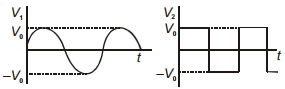
The sinusoidal potential difference $V_1$ shown in figure applied across a resistor $R$ produces heat at a rate $W$. What is the rate of heat dissipation when the square wave potential difference $V_2$ as shown in figure is applied across the resistor?
A biconvex lens has radii of curvature, $20\,cm$ each. If the refractive index of the material of the lens is $1.5$, the power of the lens is .... $D$
Mean life of a radioactive sample is $100$ seconds. Then its half life (in minutes) is
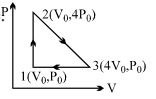
One mole of an ideal diatomic gas is taken through the cycle as shown in the figure.

 $1 \rightarrow 2 :$ isochoric process

 $2 \rightarrow 3 :$ straight line on $P-V$ diagram

  $3 \rightarrow 1 :$ isobaric process

The average molecular speed of the gas in the states $1, 2$ and $3$ are in the ratio

Two objects are thrown up at angles of $45^{\circ}$ and $60^{\circ}$ respectively, with the horizontal. If both objects attain same vertical height, then the ratio of magnitude of velocities with which these are projected is .........
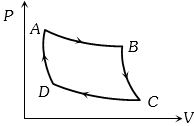
Carnot cycle (reversible) of a gas represented by a Pressure-Volume curve is shown in the diagramConsider the following statements

$I.$ Area $ABCD =$ Work done on the gas

$II.$ Area $ABCD =$ Net heat absorbed

$III.$ Change in the internal energy in cycle $= 0$

Which of these are correct

Thermal neutrons can cause fission in
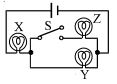
If $X, Y$ and $Z$ in figure are identical lamps, which of the following changes to the brightnesses of the lamps occur when switch $S$ is closed?