Question
A light wave can travel:

Answer

  1. In vacuum.
  1. In a material medium.
Explanation:
Light is an electromagnetic wave that can travel through vacuum or any optical medium.

Need a full question paper?

Generate a complete, print-ready paper with questions like this in minutes — across 16+ boards, with answer keys.
Start Generating Free

Similar questions

A convex lens is made of a material having refractive index $1.2$. Both the surfaces of the lens are convex. If it is dipped into water $(\mu=1.33),$ it will behave like$:$
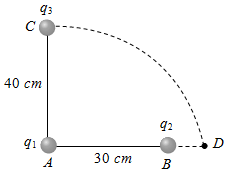
To charges $q_1$ and $q_2$ are placed $30 \ cm$ apart, shown in the figure. A third charge $q_3$ is moved along the arc of a circle of radius $40 \ cm$ from $C$ to $D$. The change in the potential energy of the system is $\frac{ q _{ s }}{4 \pi \varepsilon_0} k$, where $k$  is
To convert mechanical energy into electrical energy, one can use:
In a Rutherford scattering experiment when a projectile of charge $Z_1$ and mass $M_1$ approaches a target nucleus of charge $Z_2$ and mass $M_2,$ the distance of closest approach is $r.$ The energy of the projectile is?
The energy consumed in $1$ kilowatt electric heater in $30$ seconds will be
The absorption of radio waves by the atmosphere depends upon:
In case of a virtual and erect image, the magnification created by the mirror is:
Product of resistivity and conductivity of any conductor depends on:
The equation E = pc is valid:
  1. For an electron as well as for a photon.
  2. For an electron but not for a photon.
  3. For a photon but not for an electron.
  4. Neither for an electron nor for a photon.
A car is moving with at a constant speed of $60\ kmh^{-1}$ on a straight road. Looking at the rear view mirror, the driver finds that the car following him is at a distance of $100m$ and is approaching with a speed of $5\ kmh^{-1}.$ In order to keep track of the car in the rear, the driver begins to glance alternatively at the rear and side mirror of his car after every $2s$ till the other car overtakes. If the two cars were maintaining their speeds, which of the following statement $(s)$ is/are correct?