Question
A light wave is reflected from the mirror. The incident and the reflected waves superimpose to form stationary wave, but the nodes and anti-nodes are not seen. Why?

Answer

The distance between successive nodes or anti-nodes is $\frac{\lambda}{2}.$ The wavelength $(\lambda)$ of the light is of the order of 10-m, so the distance between successive nodes or antinodes is also of the order of 10-7m. Since this distance is very small and cannot be detected by the eye or by an ordinary optical instrument, Hence nodes and antinodes are not seen.

Need a full question paper?

Generate a complete, print-ready paper with questions like this in minutes — across 16+ boards, with answer keys.
Start Generating Free

Similar questions

A bat emits ultrasonic sound of frequency 100KHz in air. If this sound meets a water surface, what is the wave length of (a) the reflected sound, (b) transmitted sound? Speed of sound in air = 340ms-1 and in water = 1486ms-1.
Give the magnitude and direction of the net force acting on a stone of mass 0.1 kg ,
a. just after it is dropped from the window of a stationary train,
b. just after it is dropped from the window of a train running at a constant velocity of $36 km / h$.
c. just after it is dropped from the window of a train accelerating with $1 ms^{-2}$,
d. lying on the floor of a train which is accelerating with $1 ms^{-2}$, the stone being at rest relative to the train.
Neglect air resistance throughout.
A body travels uniformly a distance of $(13.8 \pm 0.2)\text{m}$ in a time $(4.0 \pm 0.3) \text{s}.$ What is the velocity of the body within error limits?
Explain why:
A brass tumbler feels much colder than a wooden tray on a chilly day.
Calculate the velocity of sound in a gas, in which two wavelengths 2.04m and 2.08m produce 20 beats in 6 seconds.
A convex lens produces a double size real image when an object is placed at a distance of 18cm from it. Where should the object be placed to produce a triple size real image?
At $t=0$, a particle is at rest at origin. Its acceleration is $2 m / s ^2$ for the first 3 s and $-2 m / s ^2$ for next 3 s . Plot the acceleration versus time and velocity versus time graph.
Two identical steel wires are under tension and are in unison. When the tension in one of the wires is increased by 1 percent, 4 beats per second is heard. Find the original frequency of the wires.
A monkey climbs up a slippery pole for 3 seconds and subsequently slips for 3 seconds. Its velocity at time t is given by v(t) = 2t(3 - t); 0 < t < 3 and v(t) = -(t - 3)(6 - t) for 3 < t < 6s in m/s. It repeats this cycle till it reaches the height of 20m.
How many cycles (counting fractions) are required to reach the top?
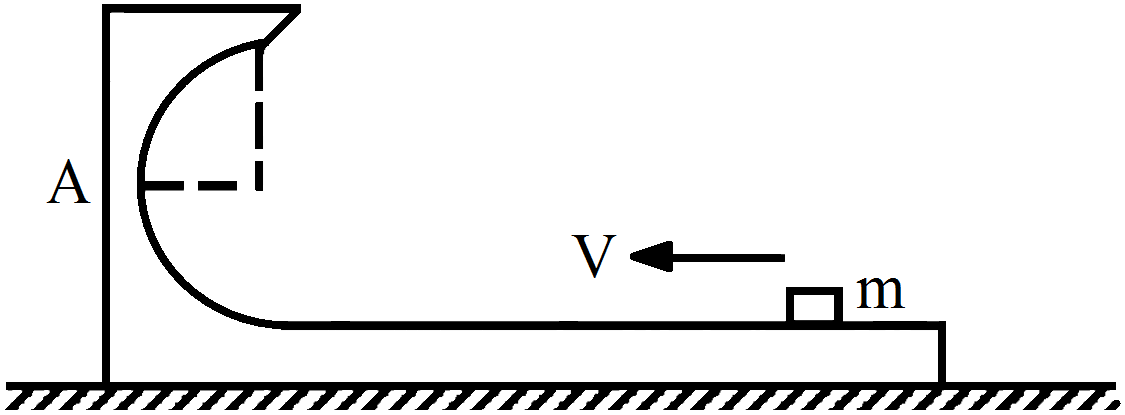
Figure shows a small block of mass m which is started with a speed v on the horizontal part of the bigger block of mass M placed on a horizontal floor. The curved part of the surface shown is semicircular. All the surfaces are frictionless. Find the speed of the bigger block when the smaller block reaches the point A of the surface.