Question
A lighter object $A$ and a heavier object $B$ are initially at rest. Both are imparted the same linear momentum. Which will start with greater kinetic energy: $A$ or $B$ or both will start with the same energy?
[Ans:$A$]

Answer

  1. Let $m_1$ and $m_2$ be the masses of light object $A$ and heavy object $B$ and $v_1$ and $v_2$ be their respective velocities.
  2. Since both are imparted with the same linear momentum,$m_1 v_1 = m_2 v_2$
  3. Kinetic energy of the lighter object A
    $= K \cdot E _{\cdot A }=\frac{1}{2} m _2 v _1^2$
    Kinetic energy of the heavier object B
    $= K \cdot E _{ B }=\frac{1}{2} m _2 v _2^2$
    $\begin{array}{ll}\therefore \quad \frac{K \cdot E_{\cdot A }}{ K \cdot E _{ B }}=\frac{\frac{1}{2} m _1 v _1^2}{\frac{1}{2} m _2 v _2^2}=\frac{\left( m _1 v _1\right)^2 / m _1}{\left( m _2 v _2\right)^2 / m _2} \\ \therefore \quad \frac{K \cdot E _{ A }}{ K \cdot E _{ B }}=\frac{ m _2}{ m _1} \quad \ldots \ldots\left[\because m _1 v _1= m _2 v _2\right]\end{array}$
     
  4. As $m_1 < m_2$, therefore $K.E._A > K.E._B$​​​​​​​, i.e, the lighter body $A$ has more kinetic energy.

Need a full question paper?

Generate a complete, print-ready paper with questions like this in minutes — across 16+ boards, with answer keys.
Start Generating Free

Similar questions

Indicators on platform, digital clocks, calculators make use of seven LEDs to indicate a number. How do you think these LEDs might be arranged?
A charge $+ q$ exerts a force of magnitude $– 0.2 N$ on another charge $-2q$. If they are separated by $25.0\ cm$, determine the value of $q$.
Explain what is doping.
Derive the expression for the critical velocity of a satellite revolving close to the surface of the Earth in terms of acceleration due to gravity.
Find the number of significant figures in the following numbers,
i. 25.42
ii. 0.004567
iii. 35.320
iv. 91.000
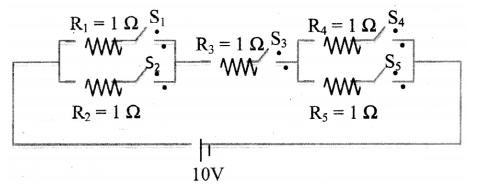
Answer the following questions from the circuit given below. [ $S_1, S_2, S_3, S_4, S_5 \Rightarrow$ Switches]. Calculate the current (I) flowing in the following cases:
i. $S _1, S_4 \rightarrow$ open; $S _2, S_3, S_5 \rightarrow$ closed.
ii. $S _2, S_5 \rightarrow$ open; $S _1, S_3, S_4 \rightarrow$ closed.
iii. $S_3 \rightarrow$ open; $S_1, S_2, S_4, S_5 \rightarrow$ closed.
Image
Explain the following terms:
i. Signal
ii. Analog signal
iii. Digital signal
iv. Transmitter
v. Transducer
vi. Receiver
vii. Attenuation
viii. Amplification
ix. Range
x. Repeater
State Newton’s formula for velocity of sound.
The Earth is rotating with angular velocity $ω$ about its own axis. $R$ is the radius of the Earth. If $Rω^2 = 0.03386 \  m/s^2,$ calculate the weight of a body of mass $100$ gram at latitude $25^\circ . (g = 9.8 \ m/s^2)$
A convex lens held some distance above a 6 cm long pencil produces its image of SOME size. On shifting the lens by a distance equal to its focal length, it again produces the image of the SAME size as earlier. Determine the image size.