Question
A line passes through (3, -1, 2) and is perpendicular to lines
$\bar{r}=(\hat{i}+\hat{j}-\hat{k})+\lambda(2 \hat{i}-2 \hat{j}+\hat{k})$ and $\bar{r}=(2 \hat{i}+\hat{j}-3 \hat{k})+\mu(\hat{i}-2 \hat{j}+2 \hat{k})$. Find its equation.
$\bar{r}=(\hat{i}+\hat{j}-\hat{k})+\lambda(2 \hat{i}-2 \hat{j}+\hat{k})$ and $\bar{r}=(2 \hat{i}+\hat{j}-3 \hat{k})+\mu(\hat{i}-2 \hat{j}+2 \hat{k})$. Find its equation.
parallel to the vector $\bar{b}=2 \hat{i}-2 \hat{j}+\hat{k}$ and the line
$\bar{r}=(2 \hat{i}+\hat{j}-3 \hat{k})+\mu(\hat{i}-2 \hat{j}+2 \hat{k})$ is parallel to the vector
$\bar{c}=\hat{i}-2 \hat{j}+2 \hat{k}$.
The vector perpendicular to the vectors $\bar{b}$ and $\bar{c}$ is given by
$\vec{b} \times \bar{c}=\left|\begin{array}{rrr}\hat{i} & \hat{j} & \hat{k} \\ 2 & -2 & 1 \\ 1 & -2 & 2\end{array}\right|$
$=\hat{i}(-4+2)-\hat{j}(4-1)+\hat{k}(-4+2)$
$=-2 \hat{i}-3 \hat{j}-2 \hat{k}$
Since the required line is perpendicular to the given lines, it is perpendicular to both $\bar{b}$ and
$\bar{C}$
$\therefore$ it is parallel to $\bar{b} \times \bar{c}$
The equation of the line passing through $A(\bar{a})$ and parallel to $\bar{b} \times \bar{c}$ is
$\bar{r}=\bar{a}+\lambda(\bar{b} \times \bar{c})$, where $\lambda$ is a scalar.
Here, $\bar{a}=3 \hat{i}-\hat{j}+2 \hat{k}$
$\therefore$ the equation of the required line is
$\bar{r}=(3 \hat{i}-\hat{j}+2 \hat{k})+\lambda(-2 \hat{i}-3 \hat{j}-2 \hat{k})$ or
$\bar{r}=(3 \hat{i}-\hat{j}+2 \hat{k})+\mu(2 \hat{i}+3 \hat{j}+2 \hat{k})$, where $\mu=-\lambda$
Generate a complete, print-ready paper with questions like this in minutes — across 16+ boards, with answer keys.
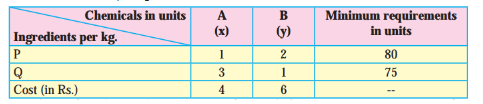
Find the number of units of chemicals A and B should be produced so as to minimize the cost.
$\tan ^{-1}\left[\frac{\cos \theta+\sin \theta}{\cos \theta-\sin \theta}\right]=\frac{\pi}{4}+\theta$ if $\theta \in\left(-\frac{\pi}{4}, \frac{\pi}{4}\right)$