MCQ
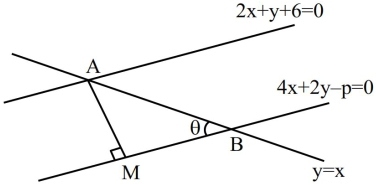
A line passes through the origin and makes equal angles with the positive coordinate axes. It intersects the lines
$
L_1: 2 x+y+6=0 \text { and } L_2: 4 x+2 y-p=0, p>0
$
at the points $A$ and $B$, respectively. If $A B=\frac{9}{\sqrt{2}}$ and the foot of the perpendicular from the point A on the line $L_2$ is $M$, then $\frac{A M}{B M}$ is equal to
  • A
    5
  • B
    4
  • C
    2
  • D
    3

Need a full question paper?

Generate a complete, print-ready paper with questions like this in minutes — across 16+ boards, with answer keys.

Start Generating Free

Similar questions

The difference between an integer and its cube is divisible by
Let $\tan ^{-1}(x) \in\left(-\frac{\pi}{2}, \frac{\pi}{2}\right)$, for $x \in \mathbb{R}$. Then the number of real solutions of the equation $\sqrt{1+\cos (2 x)}=\sqrt{2} \tan ^{-1}(\tan x)$ in the set $\left(-\frac{3 \pi}{2},-\frac{\pi}{2}\right) \cup\left(-\frac{\pi}{2}, \frac{\pi}{2}\right) \cup\left(\frac{\pi}{2}, \frac{3 \pi}{2}\right)$ is equal to
Let ${(7 + 4\sqrt 3 \,)^n} = p + \beta$ when $n$ and $p$ are positive integers and $\beta \in (0, 1)$ then $(1 - \beta ) (p + \beta )$ is
There are $n$ points in a plane of which $p$ points are collinear. How many lines can be formed from these points
The number of solutions of $y' = \frac{{y + 1}}{{x - 1}},\,y(1) = 2$ is
Let $f : N \rightarrow R$ be a function such that $f(x+y)=2 f(x) f(y)$ for natural numbers $x$ and $y$. If $f(1)=2$, then the value of $\alpha$ for which

$\sum \limits_{k=1}^{10} f(\alpha+k)=\frac{512}{3}\left(2^{20}-1\right)$ holds, is

If $\mathop {\lim }\limits_{x \to 1} \frac{{{x^2}\,\, - \,ax\, + \,b}}{{x\, - \,1}}\,\, = \,3,$ then $a + b$ is equal to
Range of ${\sin ^{ - 1\,}}\left( {\frac{{1 + {x^2}}}{{2 + {x^2}}}} \right)$ is 
The value of $\sum \limits_{n=0}^{1947} \frac{1}{2^n+\sqrt{2^{1994}}}$ is equal to
The mean and standard deviation of $40$ observations are $30$ and $5$ respectively. It was noticed that two of these observations $12$ and $10$ were wrongly recorded. If $\sigma$ is the standard deviation of the data after omitting the two wrong observations from the data, then $38 \sigma^{2}$ is equal to$.........$