MCQ
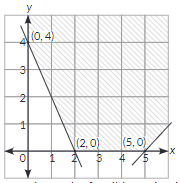
A linear programming problem (LPP) along with the graph of its constraints is shown below. The corresponding objective function is
Minimize: $Z=3 x+2 y$. The minimum value of the objective function is obtained at the corner point ( 2 , 0).
The optimal solution of the above linear programming problem $\qquad$
Image
  • A
    does not exist as the feasible region is unbounded.
  • B
    does not exist as the inequality $3 x+2 y<6$ does not have any point in common with the feasible region.
  • C
    exists as the inequality $3 x+2 y>6$ has infinitely many points in common with the feasible region.
  • exists as the inequality $3 x+2 y<6$ does not have any point in common with the feasible region.

Answer

Correct option: D.
exists as the inequality $3 x+2 y<6$ does not have any point in common with the feasible region.

Need a full question paper?

Generate a complete, print-ready paper with questions like this in minutes — across 16+ boards, with answer keys.

Start Generating Free

Similar questions

Let $[t]$ denote the greatest integer less than or equal to $\mathrm{t}$. Let $\mathrm{f}(\mathrm{x})=\mathrm{x}-[\mathrm{x}], \mathrm{g}(\mathrm{x})=1-\mathrm{x}+[\mathrm{x}]$, and $h(x)=\min \{f(x), g(x)\}, x \in[-2,2]$. Then $h$ is :
The number of arbitrary constants in the particular solution of a differential equation of third order are:
Let $ f $ and $ g$  be differentiable functions satisfying $g'(a) = 2,$ $g(a) = b$ and $fog = I$ (identity function). Then $f'(b)$ is equal to
The shaded region in the given figure is a graph of $.....$
The value of $\int \frac{\sec x}{\operatorname{cosec}^2 x} d x$
Let $\mathrm{F}:[3,5] \rightarrow \mathrm{R}$ be a twice differentiable function on $(3,5)$ such that $\mathrm{F}(\mathrm{x})=\mathrm{e}^{-\mathrm{x}}$ $\int_{3}^{x}\left(3 t^{2}+2 t+4 F^{\prime}(t)\right) \,d t$

If $F^{\prime}(4)=\frac{\alpha e^{\beta}-224}{\left(e^{\beta}-4\right)^{2}}$, then $\alpha+\beta$ is equal to $....$

The direction cosines of the normal to the plane $x + 2y - 3z + 4 = 0$ are
Let $\vec a,\vec b,\vec c$ are unit vectors and $\vec a.\vec b = \vec b.\vec c = \vec c.\vec a = \cos \theta $ then maximum value of $\theta $ is where $\theta  \in \left[ {0,\pi } \right]$
Let  $f(x)\,\, = \,\left\{ {\begin{array}{*{20}{c}}
{x\,\sin \,\frac{1}{x}\,\sin \,\left( {\frac{1}{{x\,\sin \,\frac{1}{x}}}} \right)\,,\,\,x\, \ne \,0}\\
{0\,\,\,\,\,\,\,\,\,\,\,\,\,\,\,\,\,\,\,\,\,\,\,\,\,\,\,\,\,\,\,\,\,\,\,\,\,\,\,\,\,\,\,\,\,\,\,\,\,\,\,\,\,\,\,\,\,x\, = \,0\,}
\end{array}} \right.{\mkern 1mu} $  then $f(x)$ is
The range of $\sin^{-1}\text{x}+\cos^{-1}\text{x}+\tan^{-1}\text{x}$ is: