Question
A liquid drop of diameter $D$ breaks into $27$ tiny drops. The change in energy is

Answer

$\Delta SE = 4\pi R^2T\,\,(n^{1/3}-1)$

             $= 4\pi \frac {D^2}{4}T [(27)^{1/3}-1] = 2\pi D^2T$

Need a full question paper?

Generate a complete, print-ready paper with questions like this in minutes — across 16+ boards, with answer keys.
Start Generating Free

Similar questions

Liquid oxygen remains suspended between two pole faces of a magnet because it is
A parallel plate capacitor has $1\,\mu F$ capacitance. One of its two plates is given $+2\,\mu C$ charge and the other plate, $+4\,\mu C$ charge. The potential difference developed across the capacitor is......$V$
The minimum wavelength of the $X-$ rays produced by electrons accelerated through a potential difference of $V$ volts is directly proportional to
Two wire $A$ and $B$ are stretched by same force. If, for $A$ and $B, Y_A: Y_B=1: 2, r_A: r_B=3: 1$ and $L_A: L_B=4: 1$, then ratio of their extension $\left(\frac{\Delta L_A}{\Delta L_B}\right)$ will be .............
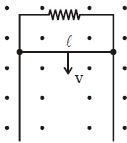
A conductor of length $l$ and mass $m$ can slide along a pair of vertical metal guides connected by a resistance $R,$ as shown in fig. Friction, resistance of conductor and guide rails are negligible. There exist a horizontal uniform magnetic field of strength $B$ normal to the plane of the page and is directed outward. The terminal speed of fall under the unfluence of gravity is, then :-
The angle between vector $\vec{Q}$ and the resultant of $(2 \overrightarrow{\mathrm{Q}}+2 \overrightarrow{\mathrm{P}})$ and $(2 \overrightarrow{\mathrm{Q}}-2 \overrightarrow{\mathrm{P}})$ is:
An aircraft is moving with a velocity of $300\,m{s^{ - 1}}.$ If all the forces acting on it are balanced, then
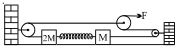
In the diagram shown, no friction at any contact surface. Initially, the spring has no deformation. What will be the maximum deformation in the spring? Consider all the strings to be sufficiency large. Consider the spring constant to be $K$.
An infinite number of charges each numerically equal to q and of the same sign are placed along the $x-$ axis at $x = 1,2,4,8.... \,metres$. Then the electric potential at $x = 0$ due to this set of charges is
An electron of stationary hydrogen atom passes from the fifth energy level to the ground level. The velocity that the atom acquired a result of photon emission will be