Question
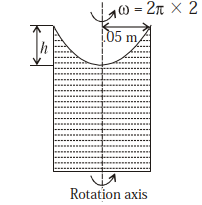
A liquid is kept in a cylindrical container which is being rotated around its axis. The support of the walls will rise higher. If the radius of the container is 0.05 m and speed of rotation is 2 revolutions per second then find the difference in height of the container between the center and the side of the container.
Need a full question paper?

Generate a complete, print-ready paper with questions like this in minutes — across 16+ boards, with answer keys.

Start Generating Free

Similar questions

If the radius of the Earth were increased by a factor of 3, by what factor would its density have to be changed to keep 'g' the same?
An object P is focused by a microscope M. A glass slab of thickness 2.1cm is introduced between P and M. If the refractive index of the slab is 1.5, by what distance should the microscope be shifted to focus the object again?
When a charged comb is brought near a small piece of paper, it attracts the piece. Does the paper become charged when the comb is brought near it?
If mercury and glass had equal coefficient of volume expansion, could we make a mercury thermometer in a glass tube?
A railway track (made of iron) is laid in winter when the average temperature is $18^{\circ} \mathrm{C}$. The track consists of sections of 12.0 m placed one after the other. How much pp should be left between two such sections 80 that there is no compression during summer when the maximum temperature goes to $48^{\circ} \mathrm{C}$ ? Coefficient of linear expansion of iron $=11 \times 10^{-6}{ }^{\circ} \mathrm{C}^{-1}$.
A particle executes the motion described by $\text{x}(\text{t})=\text{x}_0(1-\text{e}^{-\gamma\text{t}});\text{t}\ge0,\text{x}_0>0.$ Where does the particle start and with what velocity?
The drift current in a reverse-biased p-n junction increases in magnitude if the temperatu,re of the junction is increased. Explain this on the basis of creation of hole-electron pairs.
By using the method of dimension, check the accuracy of the following $\text{T}=\frac{\text{rh } \rho\text{g}}{2\cos\theta}$ where T is the surface tension, h is the height of the liquid in a capillary tube, $\rho$ is the density of the liquid, g is the acceleration due to gravity, $\theta$ is the angle of contact, and r is the radius of the capillary tube.
Two vessels $A$ and $B$ of different materials but having identical shape, size and wall thickness are filled with ice and kept at the same place. Ice melts at the rate of $100 \mathrm{~g} \mathrm{~min}^{-1}$ and $150 \mathrm{~g} \mathrm{~min}^{-1}$ in $A$ and $B$, respectively. Assuming that heat enters the vessels through the walls only, calculate the ratio of thermal conductivities of their materials.
A monkey of mass $15kg$ is climbing on a rope with one end fixed to the ceiling. If it wishes to go up with an acceleration of $1m/s^2$, how much force should it apply to the rope? If the rope is $5m$ long and the monkey starts from rest, how much time will it take to reach the ceiling?