Question
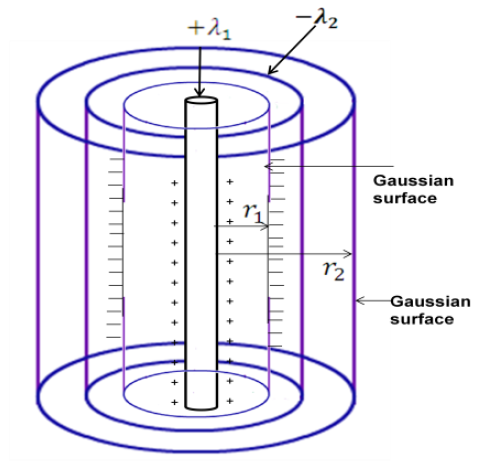
A long charged cylinder of linear charge density $+\lambda_1$ is surrounded by a hollow coaxial conducting cylinder of linear charge density $-\lambda_2$. Use Gauss’s law to obtain expressions for the electric field at a point (i) in the space between the cylinders, and (ii) outside the larger cylinder.
Answer

As Gauss’s Law states:$\oint\overrightarrow{E}.\vec{ds}=\frac{q}{\in_0}$
  1. $\oint\overrightarrow{E_1}.\vec{ds}=\frac{\lambda_1l}{\in_0}$
$\Longrightarrow\overrightarrow{E_1}=\frac{\lambda_1}{2\pi\in_0r_1}\hat{r_1}$
  1. $\oint\overrightarrow{E_2}.\vec{ds}=\frac{(\lambda_1-\lambda_2)l}{\in_0}$
$\Longrightarrow\overrightarrow{E_2}=\frac{(\lambda_1-\lambda_2)}{2\pi\in_0r_2}\hat{r_2}$

Need a full question paper?

Generate a complete, print-ready paper with questions like this in minutes — across 16+ boards, with answer keys.

Start Generating Free

Similar questions

A square coil of edge l and with n turns carries a current i. It is kept on a smooth horizontal plate. A uniform magnetic field B exists parallel to an edge. The total mass of the coil is M. What should be the minimum value of B for which the coil will start tipping over?
A small telescope has an objective lens of focal length 144 cm and an eyepiece of focal length 6.0 cm. What is the magnifying power of the telescope? What is the separation between the objective and the eyepiece?
A block of 2kg is suspended from the ceiling through a massless spring of spring constant k = 100N/m. What is the elongation of the spring? If another 1kg is added to the block, what would be the further elongation?
Given a uniformly charged plane/sheet of surface charge density, $\sigma=2\times10^{17}\text{C/m}^2.$Image
  1. Find the electric field intensity at a point A, 5mm away from the sheet on the left side.
  2. Given a straight line with three points X, Y and Z placed 50cm away from the charged sheet on the right side. At which of these points, the field due to the sheet remain the same as that of point A and why?
A parallel beam of light of wavelength $600\ nm$ is incident normally on a slit of width $0.2\ mm.$ If the resulting diffraction pattern is observed on a screen $1 m$ away, find the distance of
$a.$ first minimum, and
$b.$ second maximum, from the central maximum.
A parallel beam of light of wavelength 600nm is incident normally on a slit of width ‘a’. If the distance between the slit and the screen is 0.8 and the distance of 2nd order maximum from the centre of the screen is 1.5mm, calculate the width of the slit.
What are the dimensions of:
  1. Volume of a cube of edge a.
  2. Volume of a sphere of radius a.
  3. The ratio of the volume of a cube of edge a to the volume of a sphere of radius a?
Write symbolically the nuclear $\beta^{+}$decay process of $^{11}_{6}\text{C}$ . Is the decayed product X an isotope or isobar of $^{11}_{6}\text{C}$?
Given the mass values m $(^{11}_{6}\text{C})$ = 11·011434 u and m (X) = 11·009305 u. Estimate the Q-value in this process.
A uniform wire of resistance $100\Omega$ is melted and recast as a wire of length is double that of the original. What would be the resistance of the wire?
In a photodiode, the conductivity increases when the material is exposed to light. It is found that the conductivity changes only if the wavelength is less than 620nm. What is the band gap?