MCQ
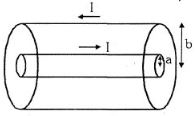
A long coaxial cable carries current $I$ (along its surface ). The current flows down the surface of inner cylinder of radius $a$ and back along the outer cylinder of radius $b$
  • A
    Energy stored in magnetic field per unit length is $\frac{{{\mu _0}{I^2}}}{{8\pi }}\ln \frac{b}{a}$
  • B
    Energy stored in magnetic field per unit length is $\frac{{{\mu _0}{I^2}}}{{2\pi }}\ln \frac{b}{a}$
  • Self inductance of given arrangement per unit length is $\frac{{{\mu _0}}}{{2\pi }}\ln \left( {\frac{b}{a}} \right)$
  • D
    Self inductance of given arrangement per unit length is $\frac{{{\mu _0}}}{{4\pi }}\ln \left( {\frac{b}{a}} \right)$

Answer

Correct option: C.
Self inductance of given arrangement per unit length is $\frac{{{\mu _0}}}{{2\pi }}\ln \left( {\frac{b}{a}} \right)$
c
$\mathrm{v}_{\mathrm{B}}-\mathrm{v}_{\mathrm{A}}=\mathrm{L} \frac{\mathrm{di}}{\mathrm{dt}} ; \mathrm{E}=\frac{1}{2} \mathrm{Li}^{2}$

Need a full question paper?

Generate a complete, print-ready paper with questions like this in minutes — across 16+ boards, with answer keys.

Start Generating Free

Similar questions

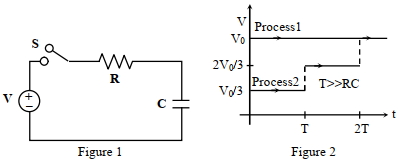
Consider a simple $RC$ circuit as shown in Figure $1$.

Process $1$: In the circuit the switch $S$ is closed at $t=0$ and the capacitor is fully charged to voltage $V_0$ (i.e. charging continues for time $T \gg R C$ ). In the process some dissipation ( $E_D$ ) occurs across the resistance $R$. The amount of energy finally stored in the fully charged capacitor is $EC$.

Process $2$: In a different process the voltage is first set to $\frac{V_0}{3}$ and maintained for a charging time $T \gg R C$. Then the voltage is raised to $\frac{2 \mathrm{~V}_0}{3}$ without discharging the capacitor and again maintained for time $\mathrm{T} \gg \mathrm{RC}$. The process is repeated one more time by raising the voltage to $V_0$ and the capacitor is charged to the same final

take $\mathrm{V}_0$ as voltage

These two processes are depicted in Figure $2$.

 ($1$) In Process $1$, the energy stored in the capacitor $E_C$ and heat dissipated across resistance $E_D$ are released by:

$[A]$ $E_C=E_D$ $[B]$ $E_C=E_D \ln 2$ $[C]$ $\mathrm{E}_{\mathrm{C}}=\frac{1}{2} \mathrm{E}_{\mathrm{D}}$ $[D]$ $E_C=2 E_D$

 ($2$) In Process $2$, total energy dissipated across the resistance $E_D$ is:

$[A]$ $\mathrm{E}_{\mathrm{D}}=\frac{1}{2} \mathrm{CV}_0^2$     $[B]$ $\mathrm{E}_{\mathrm{D}}=3\left(\frac{1}{2} \mathrm{CV}_0^2\right)$    $[C]$ $\mathrm{E}_{\mathrm{D}}=\frac{1}{3}\left(\frac{1}{2} \mathrm{CV}_0^2\right)$   $[D]$ $\mathrm{E}_{\mathrm{D}}=3 \mathrm{CV}_0^2$

Given the answer quetion  ($1$) and  ($2$)
If the refractive indices of crown glass for red, yellow and violet colours are 1.5140, 1.5170 and 1.5318 respectively and for flint glass these are 1.6434, 1.6499 and 1.6852 respectively, then the dispersive powers for crown and flint glass are respectively
A point charge is brought in an electric field. The electric field at a nearby point.
A radioactive sample is $\alpha$-emitter with half life $138.6$ days is observed by a student to have $2000$ disintegration/sec. The number of radioactive nuclei for given activity are
At which place, earth's magnetism become horizontal
A parallel plate capacitor carries a charge $q$. The distance between the plates is doubled by application of a force. The work done by the force is
An object is placed at the focus of concave lens having focal length $f$. What is the magnification and distance of the image from the optical centre of the lens?
On the bombardment of neutron with Boron. $\alpha$-particle is emitted and product nuclei formed is
The resistivity of a potentiometer wire is $40 \times {10^{ - 8}}\,ohm - m$ and its area of cross-section is $8 \times {10^{ - 6}}\,{m^2}$. If $0.2\, amp$ current is flowing through the wire, the potential gradient will be
The half-life period of radium is 1600 years. Its average life time will be