Question
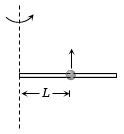
A long horizontal rod has a bead which can slide along its length, and initially placed at a distance $L$ from one end $A$ of the rod. The rod is set in angular motion about $A$ with constant angular acceleration $\alpha$. If the coefficient of friction between the rod and the bead is $\mu$, and gravity is neglected, then the time after which the bead starts slipping is
Answer

(a) Let the bead starts slipping after time$ t$

For critical condition

Frictional force provides the centripetal force

$m{\omega ^2}L = \mu \,R = \mu \,m \times {a_t} = \mu Lm\alpha $

$⇒$ $m{(\alpha t)^2}L = \mu mL\alpha $ $⇒$ $t = \sqrt {\frac{\mu }{\alpha }} $      (As $\omega = \alpha t$)

Need a full question paper?

Generate a complete, print-ready paper with questions like this in minutes — across 16+ boards, with answer keys.

Start Generating Free

Similar questions

A light string passing over a smooth light pulley connects two blocks of masses $m_1$ and $m_2$ (where $m_2>m_1$ ). If the acceleration of the system is $\frac{\mathrm{g}}{\sqrt{2}}$, then the ratio of the masses $\frac{\mathrm{m}_1}{\mathrm{~m}_2}$ is :
A body of mass $10\,kg$ moving with speed of $3 \,ms ^{-1}$ collides with another stationary body of mass $5 \,kg$. As a result, the two bodies stick together. The $KE$ of composite mass will be .......... $J$
$Assertion :$ For a gas atom the number of degrees of freedom is $3$.
$Reason :$ $\frac{{{C_P}}}{{{C_V}}} = \gamma $
A particle has initial velocity $(2\hat i + 3\hat j ) $ and has acceleration $(0.3\,\hat i + 0.2\,\hat j)$ . Its speed after $10\,s$ is
A projectile is thrown in the upward direction making an angle of $60^o$ with the horizontal direction with a velocity of $150\, ms^{-1}$. Then the time after which its inclination with the horizontal is $45^o$ is
Out of the following, choose the ray which does not travel with the velocity of light
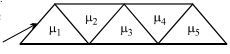
The diagram shows five isosceles right angled prisms.Alight ray incident at $90^o$ at the first face emerges at same angle with the normal from the last face. Which of the following relations will hold regarding the refractive indices?
The displacement of a particle is represented by the equation $y = sin^3\,\,\,\omega t$ . The motion is
A body of mass $M$ and charge $q$ is connected to a spring of spring constant $k$. It is oscillating along $x-$ direction about its equilibrium position, taken to be at $x = 0$, with an amplitude $A$. An electric field $E$ is applied along the $x-$ direction. Which of the following statements is correct?
The absolute zero temperature in Fahrenheit scale is........ $^oF$