MCQ
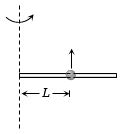
A long horizontal rod has a bead which can slide along its length, and initially placed at a distance $L$ from one end $A$ of the rod. The rod is set in angular motion about $A$ with constant angular acceleration $\alpha$. If the coefficient of friction between the rod and the bead is $\mu$, and gravity is neglected, then the time after which the bead starts slipping is
  • $\sqrt {\frac{\mu }{\alpha }} $
  • B
    $\frac{\mu }{{\sqrt \alpha }}$
  • C
    $\frac{1}{{\sqrt {\mu \alpha } }}$
  • D
    Infinitesimal

Answer

Correct option: A.
$\sqrt {\frac{\mu }{\alpha }} $
a
(a) Let the bead starts slipping after time$ t$

For critical condition

Frictional force provides the centripetal force

$m{\omega ^2}L = \mu \,R = \mu \,m \times {a_t} = \mu Lm\alpha $

$⇒$ $m{(\alpha t)^2}L = \mu mL\alpha $ $⇒$ $t = \sqrt {\frac{\mu }{\alpha }} $      (As $\omega = \alpha t$)

Need a full question paper?

Generate a complete, print-ready paper with questions like this in minutes — across 16+ boards, with answer keys.

Start Generating Free

Similar questions

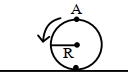
A disc is rolling without slipping on a surface. The radius of the disc is $R$. At $t=0$, the top most point on the disc is $A$ as shown in figure. When the disc completes half of its rotation, the displacement of point $A$ from its initial position is
Asufficiently long close organ pipe has a small hole at its bottom. Initially the pipe is empty. Water is poured into the pipe at a constant rate. The fundamental frequency of the air column in the pipe
A transverse wave of frequency $500 \,Hz$ and speed $100 \,m / s$ is travelling in the positive $x$-direction on a long string. At time $t=0 \,s$, the displacements at $x=0.0 \,m$ and at $x=0.25 \,m$ are $0.0 \,m$ and $0.02 \,m$, respectively. The displacement at $x=0.2 \,m$ at $t=5 \times 10^{-4} s$ is ............ $m$
At a height $0.4\, m$ from the ground, the velocity of a projectile in vector form is $\vec v = \left( {6\hat i + 2\hat j} \right)\,m/{s}$. The angle of projection is ...... $^o$ $(g = 10\, m/s^2)$ 
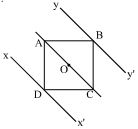
Let $I_1, I_2$ and $I_3$ be the moment of inertia of a uniform square plate about axes $AOC, xDx'$ and $yBy'$ respectively as shown in the figure. The moments of inertia of the plate $I_1 : I_2 : I_3$ are in the ratio.
An object of mass $M$ is at rest on smooth horizontal surface. Objects of different masses collide head on elastically to the object of mass $M$ . All colliding objects are having fixed same kinetic energy and in each case mass $M$ is supposed to be at rest initially. In this experiment the kinetic energy transferred to stationary mass $(M)$ depend on linear momentum of incoming colliding mass then energy transferred to $M$ in a collision is
At $27°C$ temperature, the kinetic energy of an ideal gas is ${E_1}$. If the temperature is increased to $327°C,$ then kinetic energy would be
In a Vernier Calipers. $10$ divisions of Vernier scale is equal to the $9$ divisions of main scale. When both jaws of Vernier calipers touch each other, the zero of the Vernier scale is shifted to the left of $zero$ of the main scale and $4^{\text {th }}$ Vernier scale division exactly coincides with the main scale reading. One main scale division is equal to $1\,mm$. While measuring diameter of a spherical body, the body is held between two jaws. It is now observed that zero of the Vernier scale lies between $30$ and $31$ divisions of main scale reading and $6^{\text {th }}$ Vernier scale division exactly. coincides with the main scale reading. The diameter of the spherical body will be $.......cm$
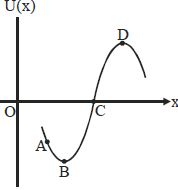
Potential energy of a particle varies with distance $x$ as shown in the graph Select the wrong statement
A 20cm long capillary tube is dipped in water. The water rises up to 8cm. If the entire arrangement is put in a freely falling elevator, the length of water column in the capillary tube will be: