Question
A long, straight wire carries a current. Is Ampere's law valid for a loop that does not enclose the wire? That encloses the wire but is not circular?
Generate a complete, print-ready paper with questions like this in minutes — across 16+ boards, with answer keys.
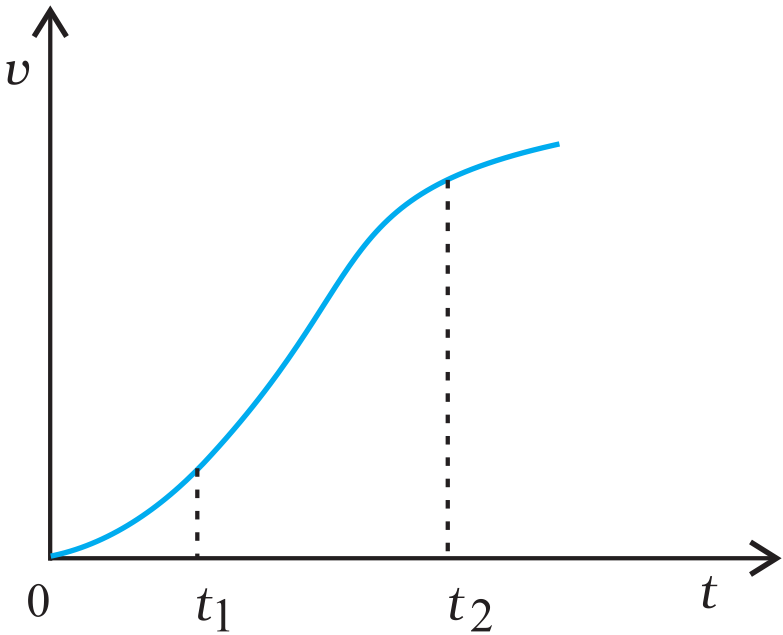
Which of the following formulae are correct for describing the motion of the particle over the time-interval t1 to t2:
x(t2) = x(t1) + v(t1) (t2 – t1) + (1/2) a(t2 – t1)2
v(t2) = v(t1) + a(t2 – t1)
vaverage = (x(t2) –x(t1))/(t2 – t1)
aaverage = (v(t2) –v(t1))/(t2 – t1)
x(t2) = x(t1) + vaverage (t2 – t1) + (1/2) aaverage (t2 – t1)2
x(t2) – x(t1) = area under the v-t curve bounded by the t-axis and the dotted line shown.
$\text{x}=2\cos\pi\text{t}$