Question
A long, straight wire carries a current. Is Ampere's law valid for a loop that does not enclose the wire? That encloses the wire but is not circular?

Answer

Ampere's law is valid for a loop that is not circular. However, it should have some charge distribution in the area enclosed so as to have a constant electric field in the region and a non-zero magnetic field. Even if the loop defined does not have its own charge distribution but has electric influence of some other charge distribution, it can have some constant magnetic field $\big(\oint\overrightarrow{\text{B}}.\text{d}\overrightarrow{\text{l}}=\mu_0\text{i}\ \text{enclosed}\big).$

Need a full question paper?

Generate a complete, print-ready paper with questions like this in minutes — across 16+ boards, with answer keys.
Start Generating Free

Similar questions

The electric field in a region is given by $\overrightarrow{\text{E}}=\frac{3}{5}\text{E}_0\overrightarrow{\text{i}}+\frac{4}{5}\text{E}_0\overrightarrow{\text{j}}$ with $\text{E}_0=2.0\times10^3\text{NC}^{-1}.$ Find the flux of this field through a rectangular surface of area $0.2m^2$ parallel to the y-z plane.
Two concentric circular coils X and Y of radii 16 cm and 10 cm, respectively, lie in the same vertical plane containing the north to south direction. Coil X has 20 turns and carries a current of 16 A; coil Y has 25 turns and carries a current of 18 A. The sense of the current in X is anticlockwise, and clockwise in Y, for an observer looking at the coils facing west. Give the magnitude and direction of the net magnetic field due to the coils at their centre.
Answer the following question:
Why must both the objective and the eyepiece of a compound microscope have short focal lengths?
In a Geiger - Marsden experiment, calculate the distance of closest approach to the nucleus of Z = 80, when an α-particle of 8 MeV nergy impinges on it before it comes momentarily to rest and reverses its direction.
How will the distance of closest approach be affected when the kinetic energy of the α-particle is doubled?
Is it easier to take out a nucleon from carbon or from iron? Fi-om iron or from lead?
A plate of area $10 \mathrm{~cm}^2$ is to be electroplated with copper (density $9000 \mathrm{~kg} / \mathrm{m}^3$ ) to a thickness of 10 micrometres on both sides, using a cell of 12 V . Calculate the energy spent by the cell in the process of deposition. If this energy is used to heat 100 g of water, calculate the rise in the temperature of the water. ECE of copper $=3 \times 10^{-7} \mathrm{~kg} \mathrm{C}^{-1}$ and specific heat capacity of water $=4200 \mathrm{Jkg}^{-1}$.
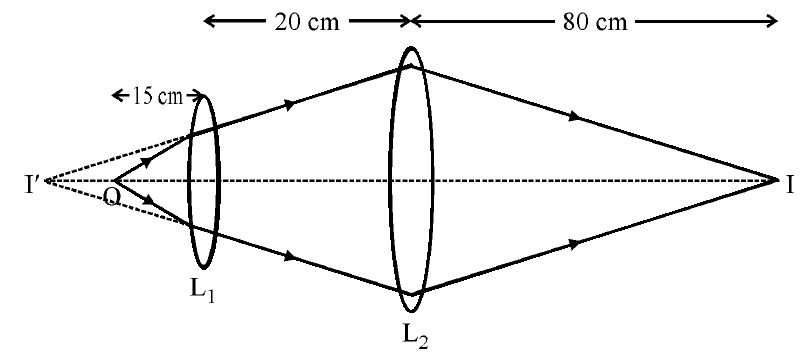
In the following diagram, an object ‘O’ is placed 15 cm in front of a convex lens $L_1$ of focal length 20 cm and the final image is formed at ‘I’ at a distance of 80 cm from the second lens $L_2.$ Find the focal length of the lens $L_2.$​​​​​​​
A circular coil of radius $10 cm , 500$ turns and resistance $2 \Omega$ is placed with its plane perpendicular to the horizontal component of the earth's magnetic field. It is rotated about its vertical diameter through $180^{\circ}$ in $0.25 s$. Estimate the magnitudes of the emf and current induced in the coil. Horizontal component of the earth's magnetic field at the place is $3.0 \times 10^{-5} T$.
How much energy is released in the following reaction?
$\text{ }^7\text{Li + p}\rightarrow\alpha+\alpha.$
Atomic mass of $^7Li = 7.0160u$ and that of $^4He = 4.0026u.$
The temperature and relative humidity in a room are 300K and 20% respectively. The volume of the room is $50m^3.$ The saturation vapour pressure at 300K is 3.3kPa. Calculate the mass of the water vapour present in the room.