Question
A magnetic field can be produced by:

Answer

  1. Both of these.
Explanation:
A moving charge and changing electric field both produces magnetic field.

Need a full question paper?

Generate a complete, print-ready paper with questions like this in minutes — across 16+ boards, with answer keys.
Start Generating Free

Similar questions

A capacitor with air as the dielectric is charged to a potential of  100 volts. If the space between the plates is now filled with a dielectric of dielectric constant 10, the potential difference between the plates will be(a) 1000  volts (b) 100 volts (c) 10 volts(d) Zero
       
 What is the full form of UHF?
Optical fibre communication is based on which of the following phenomena :
A piece of semiconductor is connected in series in an electric circuit. On increasing the temperature, the current in the circuit will(a) Decrease(b) Remain unchanged(c) Increase(d) Stop flowing
       
A charge of 1C is moving in a magnetic field of 0.5Tesla with a velocity of 10m/sec Perpendicular to the field. Force experienced is(a) 5 N(b) 10 N(b) 10 N(d) 0 N
       
A parallel plate air capacitor has capacity ′C′ farad, potential ′V′ volt and energy ′E′ joule. When the gap between the plates is completely filled with dielectric.
A semiconductor dopped with a donor impurity is (a) P-type (b) N-type (c) NPN type (d) PNP type
       
Two metallic plates $A$ and $B,$ each of area $5 ´ 10^{–4}m^2$ are placed parallel to each other at a separation of $1 \ cm$. Plate $B$ carries a positive charge of $33.7\ pc$. A monochromatic beam of light, with photons of energy $5\ eV$ each, starts falling on plate $A$ at $t = 0,$ so that $10^{16}$ photons fall on it per square meter per second. Assume that one photoelectron is emitted for every $10^6$ incident photons. Also assume that all the emitted photoelectrons are collected by plate $B$ and the work function of plate $A$ remains constant at the value $2\ eV$. Electric field between the plates at the end of $10$ seconds is
Which of the following is used in the Davisson – Germer experiment?
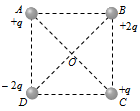
Four charges are arranged at the corners of a square $\text{ABCD},$ as shown in the adjoining figure. The force on the charge kept at the centre $O$ is