Question
A magnetic field cannot exert any force on a:

Answer

  1. Stationary charge
Explanation:
Magnetic fields are produced by magnetic bodies (Moving or stationary).
Moving charges produce electromagnetic fields. Stationary charges produce electric fields alone.

Need a full question paper?

Generate a complete, print-ready paper with questions like this in minutes — across 16+ boards, with answer keys.
Start Generating Free

Similar questions

The length of the optical path of two media in contact of length $d_1$ and $d_2$ of refractive indices $\mu_1$  and $\mu_2$ respectively, is
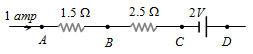
In the circuit element given here, if the potential at point $B, V_B = 0,$ then the potentials of $A$ and $D$ are given as
Which of the following phenomena can explain quantum nature of light(a) Photoelectric effect(b) Interference(c) Diffraction(d) Polarisation
       
What happens when some charge is placed on a soap bubble?
What is the net electric field in the outer regions above the upper plate and below the lower plate in a parallel plate capacitor?
Two thin lenses of focal lengths 20 cm and 25 cm are placed in contact convex. The effective power of the combination is(a) 45 dioptres(b) 9 dioptres(c) 1/9 dioptre(d) 6 dioptres
       
The hottest planet of solar system is(a) Mars (b) Mercury(c) Venus(d) Pluto
       
A particle moves with a constant velocity parallel to the X-axis. Its angular momentum with respect to the origin:
  1. Is zero.
  2. Remains constant.
  3. Goes on Increasing.
  4. Goes on decreasing.
A circular coil of radius $4 \ cm$ and of $20$ turns carries a current of $3$ amperes. It is placed in a magnetic field of intensity of $0.5$ weber $/ m ^2$. The magnetic dipole moment of the coil is
Two circuits have coefficient of mutual induction of 0.09 henry. Average e.m.f. induced in the secondary by a change of current from 0 to 20 ampere in 0.006 second in the primary will be(a) 120 V(b) 80 V(c) 200 V (d) 300 V