Question
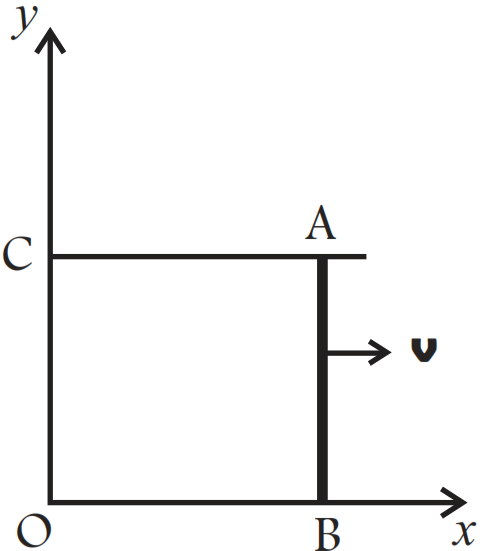
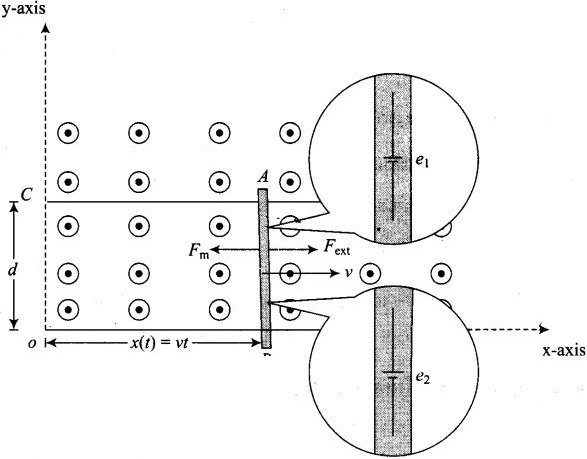
A magnetic field $\text{B}=\text{B}_0\sin(\omega\text{t})\hat{\text{k}}$ covers a large region where a wire AB slides smoothly over two parallel conductors separated by a distance d (Fig.). The wires are in the x-y plane. The wire AB (of length d) has resistance R and the parallel wires have negligible resistance. If AB is moving with velocity v, what is the current in the circuit. What is the force needed to keep the wire moving at constant velocity?
Answer

Key concept: In this problem the emf induced across AB is motional emf due to its motion, and emf induced by change in magnetic flux linked with the loop change due to change of magnetic field.
Due to motion: e = Blv
Due to change in magnetic flux: $\text{e}=-\text{N}\frac{\text{d}(\phi_\text{B})}{\text{dt}}$
First we have to analyse the situation as shown in the figure, Let the parallel wires are at y = 0 and y = d and placed along x-axis. Wire AB is along y-axis.
Let us redraw the diagram as shown below.

At t = 0, wire AB starts from x = 0 and moves with a velocity v. Let at time t, wire is at x(t) = vt
(where, x(t) is the dispacement as a function of time).
Now, the motional emf across AB is
$\text{e}_1=\frac{\text{B}}{\text{v}}$
$\Rightarrow\ \text{e}_1=\big(\text{B}_0\sin\omega\text{t}\big)\text{vd}(-\hat{\text{j}})$
and emf due to change in field (along OBAC)
$\text{e}_2=-\frac{\text{d}(\phi_\text{B})}{\text{dt}}$
$\phi_\text{B}=(\text{B}_0\sin\omega\text{t})(\text{x}(\text{t})\text{d}) \ \ (\text{where, area A}=\text{xd})$
$\text{e}_2=-\text{B}_0\omega\cos\omega\text{tx}(\text{t})\text{d}$
Total emf in the circuit = emf due to change in field (along OBAC) + the motional emf across AB
$\text{e}_1+\text{e}_2=-\text{B}_0\text{d}\big[\omega\text{x}\cos(\omega\text{t})+\text{v}\sin(\omega\text{t})\big]$
The equivalent electrical diagram is shown in the diagram below.

Electric current in clockwise direction is given by
$=\frac{\text{B}_0\text{d}}{\text{R}}(\omega\text{x}\cos\omega\text{t}+\text{v}\sin\omega\text{t})$
The force acting on the conductor is given by $\text{F}=\text{ilB}\sin90^\circ=\text{ilB}$.
Substituting the values,
$\vec{\text{F}_\text{M}}=\frac{\text{B}_0\text{d}}{\text{R}}(\omega\text{t}\cos\omega\text{t}+\text{v}\sin\omega\text{t})(\text{d})(\text{B}_0\sin\omega\text{t})(-\hat{\text{j}})$
External force needed on wire is along positive x-axis to keep moving it with constant velocity is given by,
$\vec{\text{F}}_\text{ext}=\frac{\text{B}_0\text{d}}{\text{R}}(\omega\text{t}\cos\omega\text{t}+\text{v}\sin\omega\text{t})\sin\omega\text{t}$
This is the required expression for force.

Need a full question paper?

Generate a complete, print-ready paper with questions like this in minutes — across 16+ boards, with answer keys.

Start Generating Free

Similar questions

A ball is kept at a height h above the surface of a heavy transparent sphere made of a material of refractive index $\mu.$ The radius of the sphere is R. At t = 0, the ball is dropped to fall normally on the sphere. Find the speed of the image formed as a function of time for $\text{t}<\sqrt{\frac{2\text{h}}{\text{g}}}.$ Consider only the image by a single refraction.
Consider a system of n charges $q_1, q_2, ... q_n$ with position vectors $\vec{\text{r}}_1,\vec{\text{r}}_2,\vec{\text{r}}_3,...\vec{\text{r}}_\text{n}$ relative to some origin ‘O’. Deduce the expression for the net electric field $\vec{\text{E}}$ at a point P with position vector $\vec{\text{r}}_\text{p},$ due to this system of charges.
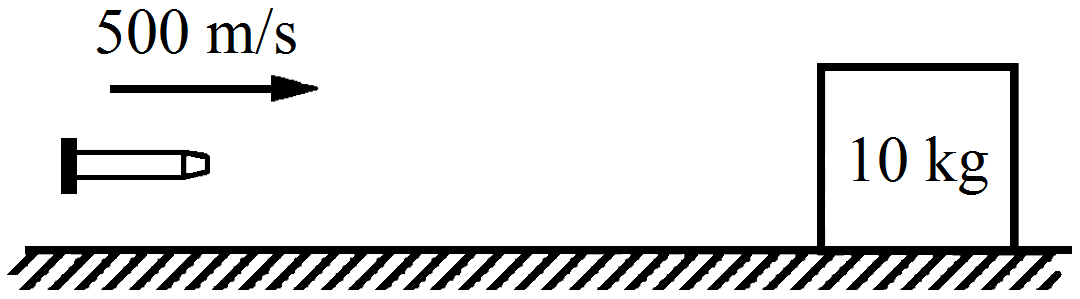
A bullet of mass 20g travelling horizontally with a speed of 500m/s passes through a wooden block of mass 10.0kg initially at rest on a level surface. The bullet emerges with a speed of 100m/s and the block slides 20cm on the surface before coming to rest. Find the friction coefficient between the block and the surface.
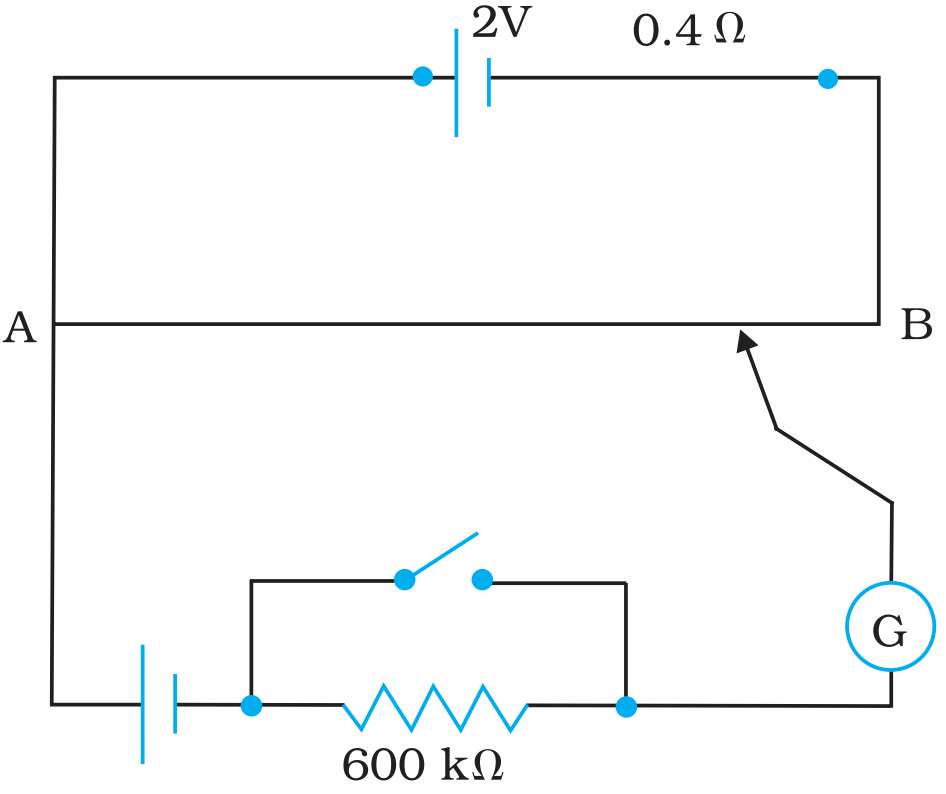
Figure shows a potentiometer with a cell of 2.0 V and internal resistance $0.04\ \Omega$ maintaining a potential drop across the resistor wire AB. A standard cell which maintains a constant emf of 1.02 V (for very moderate currents upto a few mA) gives a balance point at 67.3 cm length of the wire. To ensure very low currents drawn from the standard cell, a very high resistance of $600\ \text{k}\Omega$ is put in series with it, which is shorted close to the balance point. The standard cell is then replaced by a cell of unknown emf $\varepsilon$ and the balance point found similarly, turns out to be at 82.3 cm length of the wire.
  1. What is the value $\varepsilon?$
  2. What purpose does the high resistance of $600\ \text{k}\Omega$ have?
  3. Is the balance point affected by this high resistance?
  4. Is the balance point affected by the internal resistance of the driver cell?
  5. Would the method work in the above situation if the driver cell of the potentiometer had an emf of 1.0 V instead of 2.0 V?
  6. Would the circuit work well for determining an extremely small emf, say of the order of a few mV (such as the typical emf of a thermo-couple)? If not, how will you modify the circuit?
A long straight cable of length l is placed symmetrically along z-axis and has radius a(< < l). The cable consists of a thin wire and a co-axial conducting tube. An alternating current $\text{I}(\text{t})=\text{I}_0\sin(2\pi\text{vt})$ flows down the central thin wire and returns along the co-axial conducting tube. The induced electric field at a distance s from the wire inside the cable is $\text{E}(\text{s},\text{t})=\mu_0\text{I}_0\text{v}\cos(2\pi\text{vt})\text{In}\Big(\frac{\text{s}}{\text{a}}\Big)\hat{\text{k}}$.
  1. Calculate the displacement current density inside the cable.
  2. Integrate the displacement current density across the crosssection of the cable to find the total displacement current $I^d.$
  3. Compare the conduction current $I_0$​​​​​​​ with the dispalcement current $\text{I}_0^\text{d}$.
Define total internal reflection. Establish the relation between $u, v$ and $f$ for a spherical mirror. Draw the necessary ray diagram. ### Define lateral displacement. Derive the lens maker formula.
$
\frac{1}{f}=\left(n_{21}-1\right)\left(\frac{1}{R_1}-\frac{1}{R_2}\right)
$
Draw the necessary ray diagram. (Where the signs have their usual meanings.)
$a.$ Derive an expression for the energy stored in a parallel plate capacitor of capacitance $C$ when charged up to voltage $V$. How is this energy stored in the capacitor?
$b.$ A capacitor of capacitance $1 \mu F$ is charged by connecting a battery of negligible internal resistance and emf $10 V$ across it. Calculate the amount of charge supplied by the battery in charging the capacitor fully.
  1. Define mutual inductance and write its S.I. unit.
  2. Derive an expression for the mutual inductance of two long co-axial solenoids of same length wound one over the other.
  3. In an experiment, two coils $c_1 $ and $c_2$ are placed close to each other. Find out the expression for the emf induced in the coil $c_1$ due to a change in the current through the coil $c_2.$
$a.$ Explain why, for any charge configuration, the equipotential surface through a point is normal to the electric field at that point.
Draw a sketch of equipotential surfaces due to a single charge $(-q)$, depicting the electric field lines due to the charge.
$b.$ Obtain an expression for the work done to dissociate the system of three charges placed at the vertices of an equilateral triangle of side a as shown alongside.
Exlplain ac voltage applied on a series LCR circuit. Explain its solution by phasor diagram.