MCQ
A magnetic needle is kept in a non-uniform magnetic field. lt experiences
  • A force and a torque
  • B
    A force but not a torque
  • C
    A torque but not a force
  • D
    Neither a torque nor a force

Answer

Correct option: A.
A force and a torque

Need a full question paper?

Generate a complete, print-ready paper with questions like this in minutes — across 16+ boards, with answer keys.

Start Generating Free

Similar questions

Assertion : Voltmeter is connected in parallel with the circuit.

Reason : Resistance of a voltmeter is very large.
If wavelength of a wave is $\lambda=6000 \mathring A$. Then wave number will be
In a dc motor, induced e.m.f. will be maximum
A moving coil galvanometer has $50$ turns and each turn has an area $2 \times 10^{-4} m ^2$. The magnetic field produced by the magnet inside the galvanometer is $0.02 T$. The torsional constant of the suspension wire is $10^{-4} N m rad ^{-1}$. When a current flows through the galvanometer, a full scale deflection occurs if the coil rotates by $0.2$ rad. The resistance of the coil of the galvanometer is $50 \Omega$. This galvanometer is to be converted into an ammeter capable of measuring current in the range $0-1.0 A$. For this purpose, a shunt resistance is to be added in parallel to the galvanometer. The value of this shunt resistance, in ohms, is. . . . . .
When two bodies stick together after collision, the collision is said to be
The kinetic energy of an electron with de-Broglie wavelength of $0.3$ nanometer is
Two forces are such that the sum of their magnitudes is $18 N$ and their resultant is perpendicular to the smaller force and magnitude of resultant is $12 N$. Then the magnitudes of the forces are
Two short magnets having magnetic moments in the ratio $27: 8$, when placed on opposite sides of a deflection magnetometer, produce no deflection. If the distance of the weaker magnet is $0.12 \mathrm{~m}$ from the centre of deflection magnetometer, the distance of the stronger magnet from the centre is
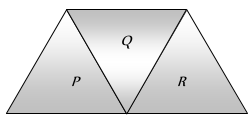
A given ray of light suffers minimum deviation in an equilateral prism $P$. Additional prisms $Q$ and $R$ of identical shape and material are now added to $P$ as shown in the figure. The ray will suffer
Image
For an adiabatic expansion of a perfect gas, the value of $\frac{\Delta P}{P}$ is equal to