A mass at the end of a spring executes harmonic motion about an equilibrium position with an amplitude $A.$ Its speed as it passes through the equilibrium position is $V.$ If extended $2A$ and released, the speed of the mass passing through the equilibrium position will be
Medium


Download our appand get started for free
Experience the future of education. Simply download our apps or reach out to us for more information. Let's shape the future of learning together!No signup needed.*
Similar Questions
- 1A particle is executing simple harmonic motion with an amplitude of $0.02$ metre and frequency $50\, Hz$. The maximum acceleration of the particle isView Solution
- 2Due to some force $F_1$ a body oscillates with period $4/5\, sec$ and due to other force $F_2$ oscillates with period $3/5\, sec$. If both forces act simultaneously, the new period will be .... $\sec$View Solution
- 3At time $t = 0$, a simple harmonic oscillator is at its extreme position. If it covers half of the amplitude distance in $1\, second$, then the time period of oscillation is ..... $s$View Solution
- 4The $K.E.$ and $P.E.$ of a particle executing $SHM$ with amplitude $A$ will be equal when its displacement is-View Solution
- 5A particle is executing $S.H.M.$ with time period $T^{\prime}$. If time period of its total mechanical energy is $T$ then $\frac{T^{\prime}}{T}$ is ........View Solution
- 6A massless spring $(k = 800\, N/m)$, attached with a mass $(500\, g)$ is completely immersed in $1\, kg$ of water. The spring is stretched by $2\, cm$ and released so that it starts vibrating. What would be the order of magnitude of the change in the temperature of water when the vibrations stop completely? (Assume that the water container and spring receive negligible heat and specific heat of mass $= 400\, J/kg\, K$, specific heat of water $= 4184\, J/kg\, K$)View Solution
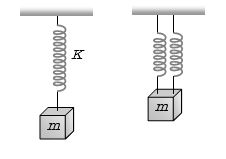
- 7A mass m performs oscillations of period $T$ when hanged by spring of force constant $K$. If spring is cut in two parts and arranged in parallel and same mass is oscillated by them, then the new time period will beView Solution
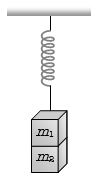
- 8Two masses $m_1$ and $m_2$ are suspended together by a massless spring of constant $K$. When the masses are in equilibrium, $m_1$ is removed without disturbing the system. The amplitude of oscillations isView Solution
- 9On a planet a freely falling body takes $2 \,sec$ when it is dropped from a height of $8 \,m$, the time period of simple pendulum of length $1\, m$ on that planet is ..... $\sec$View Solution
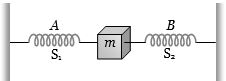
- 10In the figure, ${S_1}$ and ${S_2}$ are identical springs. The oscillation frequency of the mass $m$ is $f$. If one spring is removed, the frequency will becomeView Solution