Question
A mass attached to a spring is free to oscillate, with angular velocity $\omega,$ in a horizontal plane without friction or damping. It is pulled to a distance $x_0$ and pushed towards the centre with a velocity $\upsilon_0$ at time t = 0. Determine the amplitude of the resulting oscillations in terms of the parameters $\omega,x_0$ and $υ_0$. [Hint: Start with the equation $\text{x}=\text{a}\cos(\omega\text{t}+\theta)$ and note that the initial velocity is negative.]
 

Answer

The displacement rquation for an oscillating mass is given by:$\text{x}=\text{A}\cos(\omega\text{t}+\theta)$
where,
A is the amplitude
x is the displacement
$\theta$ is the phase constant
Velcoity, $\text{v}=\frac{\text{dx}}{\text{dt}}=-\text{A}\omega\sin(\omega\text{t}+\theta)$
At, $t = 0, x = x_0$
$\text{x}_0=\text{A}\cos\theta=\text{x}_0\ .....(\text{i})$
and, $\frac{\text{dx}}{\text{dt}}=-v_0=\text{A}\omega\sin\theta$
$\text{A}\sin\theta=\frac{v_0}{\omega}\ ....(\text{ii})$
Squaring and adding equations (i) and (ii), we get:
$\text{A}^2(\cos^2\theta+\sin^2\theta)=\text{x}_0^2+\Big(\frac{v_0^2}{\omega^2}\Big)$
$\therefore\ \text{A}=\sqrt{\text{x}_0^2+\Big(\frac{v_0}{\omega}\Big)^2}$
Hence, the amplitude of the resulting oscillation is $\text{x}_0^2+\Big(\frac{v_0}{\omega}\Big)^2.$

Need a full question paper?

Generate a complete, print-ready paper with questions like this in minutes — across 16+ boards, with answer keys.

Start Generating Free

Similar questions

State the law of equipartition of energy of a dynamic system and use it to find the values of internal energy and the ratio of the specific heats of (a) monoatomic, (b) diatomic, (c) triatomic gas molecules.
Two identical balls A and B undergo a perfectly elastic two dimensional collision. Initially A is moving with a speed of $10ms^{-1}$ and B is at rest. Due to collision A is scattered through angle of $30°$. What are the speed of A and B after the collision?
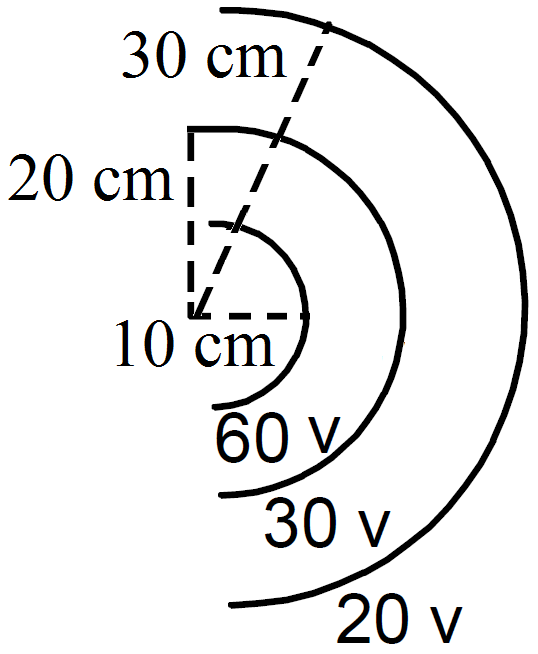
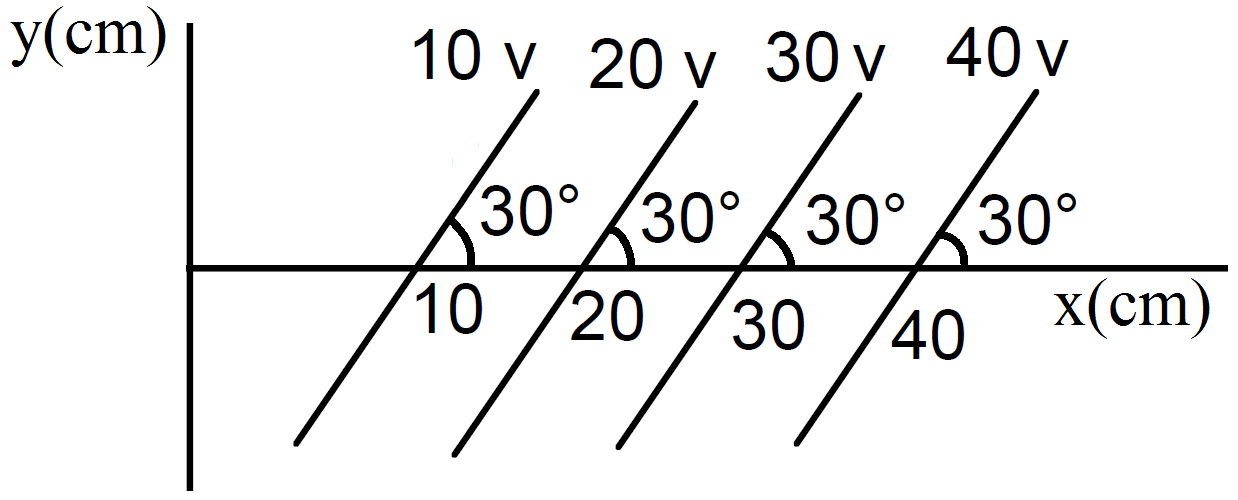
Some equipotential surfaces are shown in figure. What can you say about the magnitude and the direction of the electric field?

A block is kept on a horizontal table. The table is undergoing S.H.M. of frequency 3Hz in a horizontal plane. The coefficient of static friction between block and the table surface is 0.72. Find the maximum amplitude of the table at which the block does not slip on the surface.
A mass m moving with a speed u collides with a similar mass m at rest, elastically and obliquely. Prove that they will move in directions making an angle $\frac{\pi}{2}$ with each other.
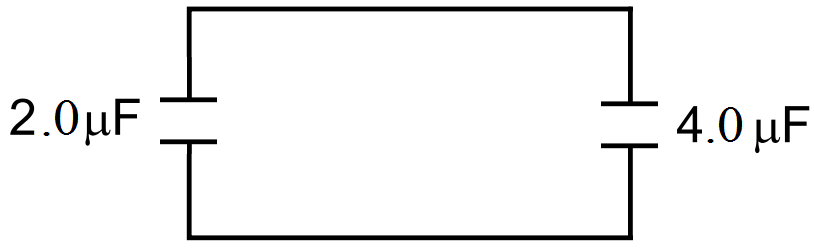
A capacitor of capacitance $2.0\mu\text{F}$ is charged to a potential difference of $12V$. It is then connected to an uncharged capacitor of capacitance $4.0\mu\text{F}$ as shown in figure. Find:
  1. The charge on each of the two capacitors after the connection.
  2. The electrostatic energy stored in each of the two capacitors.
  3. The heat produced during the charge transfer from one capacitor to the other.
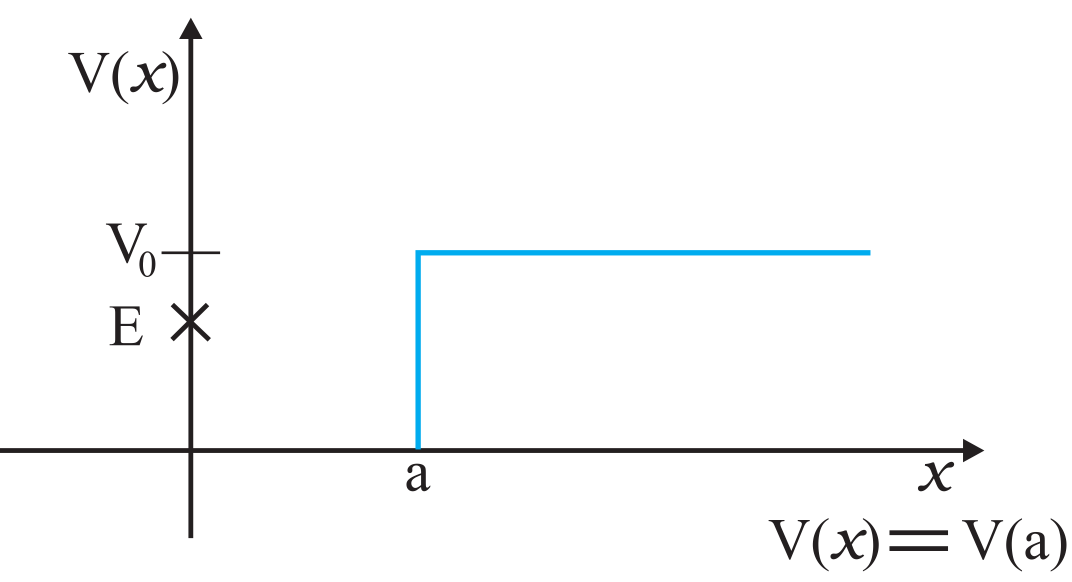
Given in are examples of some potential energy functions in one dimension. The total energy of the particle is indicated by a cross on the ordinate axis. In each case, specify the regions, if any, in which the particle cannot be found for the given energy. Also, indicate the minimum total energy the particle must have in each case. Think of simple physical contexts for which these potential energy shapes are relevan.
A satellite orbits the earth at a height of 400 km above the surface. How much energy must be expended to rocket the satellite out of the earth's gravitational influence? Mass of the satellite $=200 \mathrm{~kg}$; mass of the earth $=6.0 \times$ $10^{24} \mathrm{~kg}$; radius of the earth $=6.4 \times 10^6 \mathrm{~m} ; \mathrm{G}=6.67 \times 10^{-11} \mathrm{~N} \mathrm{~m}^2 \mathrm{~kg}^{-2}$.
An object is moving along $x-$axis in such a way that its displacement is given by $x = 30 + 20t^2$
where $x$ is in metres and $t$ is in seconds.
  1. Find the velocity and acceleration.
  2. What are the initial position and the velocity of the object?
A group of clouds at a height of $500m$ above the earth burst and cause enough rainfall to cover an area of $106m$ 2 with a depth of $2cm$. How much work would have been done in raising water to the height of clouds?