Question
A mass attached to a spring is free to oscillate, with angular velocity $\omega,$ in a horizontal plane without friction or damping. It is pulled to a distance $x_0$ and pushed towards the centre with a velocity $\upsilon_0$ at time $t = 0$. Determine the amplitude of the resulting oscillations in terms of the parameters $\omega, x_0$ and $\upsilon_0.$ [Hint: Start with the equation $\text{x}=\text{a}\cos(\omega\text{t}+\theta)$ and note that the initial velocity is negative.]
Answer

The displacement rquation for an oscillating mass is given by:$\text{x}=\text{A}\cos(\omega\text{t}+\theta)$
where,
A is the amplitude
x is the displacement
$\theta$ is the phase constant
Velcoity, $\text{v}=\frac{\text{dx}}{\text{dt}}=-\text{A}\omega\sin(\omega\text{t}+\theta)$
At, $t = 0, x = x_0$
$\text{x}_0=\text{A}\cos\theta=\text{x}_0\ .....(\text{i})$
and, $\frac{\text{dx}}{\text{dt}}=-v_0=\text{A}\omega\sin\theta$
$\text{A}\sin\theta=\frac{v_0}{\omega}\ ....(\text{ii})$
Squaring and adding equations (i) and (ii), we get:
$\text{A}^2(\cos^2\theta+\sin^2\theta)=\text{x}_0^2+\Big(\frac{v_0^2}{\omega^2}\Big)$
$\therefore\ \text{A}=\sqrt{\text{x}_0^2+\Big(\frac{v_0}{\omega}\Big)^2}$
Hence, the amplitude of the resulting oscillation is $\text{x}_0^2+\Big(\frac{v_0}{\omega}\Big)^2.$

Need a full question paper?

Generate a complete, print-ready paper with questions like this in minutes — across 16+ boards, with answer keys.

Start Generating Free

Similar questions

The magnetic field in a region is given by $\vec{\text{B}}=\vec{\text{k}}\frac{\text{B}_0}{\text{L}}\text{y}$ where L is a fixed length. A conductihg rod of of length lies along the Y-axis between the origin and the point (0, L, 0). If the rod moves with a velocity $\text{v}=\text{v}_0\vec{\text{i}},$ find the emf induced between the ends of the rod.
In en experiment on photoelectric effect, light of wavelength $400$ run is incident on a cesium plate at the rate of $5.0W$. The potential of the collector plate is made sufficiently positive with respect to the emitter so that the current reaches its saturation value. Assuming that on the average one out of every $10°$ photons is able to eject a photoelectron, find the photocurrent in the circuit.
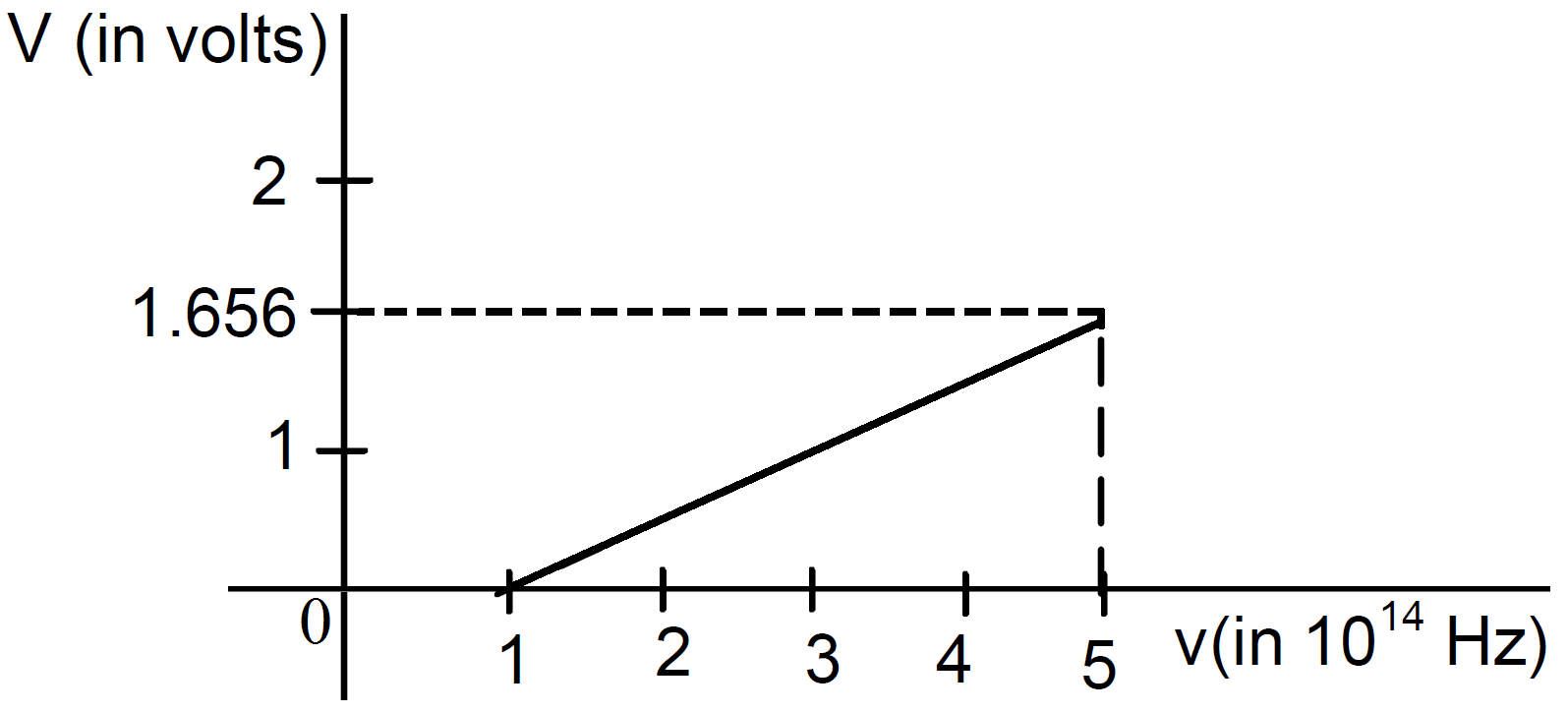
Figure is the plot of the stopping potential versus the frequency of the light used in an experiment on photoelectric effect. Find.
  1. The ratio h/e and.
  2. The work function.
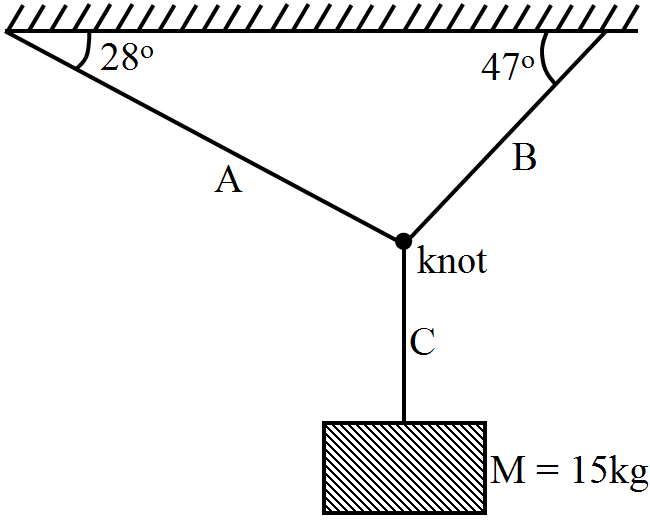
A block of mass $15kg$ hangs from three chords as shown in figure. What are the tensions in the chords?
Use the formula $\text{v}=\sqrt{\frac{\gamma\text{P}}{\rho}}$ to explain why the speed of sound in air:
Is independent of pressure,
What is the principle of superposition? On what factors frequency and amplitude of the resultant wave depend? What effect can be produced by the superposi- tion of two sound waves? Exaplain interference of sound wave and analyze it mathematically.
Derive an expression for the moment of inertia of a thin uniform rod about an axis passing through its one end and perpendicular to its length. Also determine the radius of gyration about the same axis.
Is it possibe for a body to have inertia but no weight?
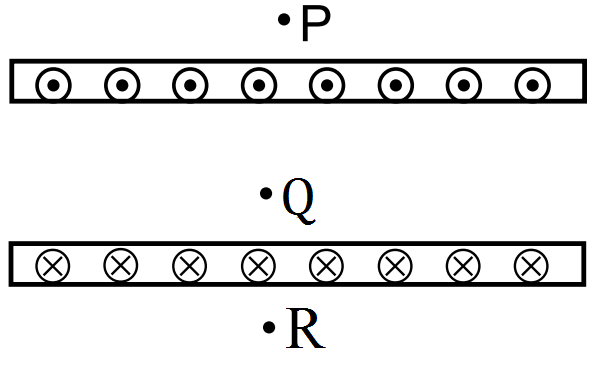
Two large metal sheets carry surface currents as shown in figure. The current through a strip of width dl is Kdl where K is a constant. Find the magnetic field at the points P, Q and R.
A ball falls on an inclined plane of inclination $\theta$ from a height h above the point of impact and makes a perfectly elastic collision. Where will it hit the plane again?